
Mormon Coffee

It’s forbidden, but it’s good!

Just who makes up LDS doctrine?

One of the things most puzzling to me as an associate in this ministry is when I am told that I cannot truly understand the teachings of the LDS religion. Dozens of times Mormons have told me, “What you’re saying is not what we (Mormons) believe,” even though the doctrine I am describing normally comes straight from the standard works or the authoritative speeches and writings of the general authorities. What is the reason given for why my research ought to be invalidated? It’s because I’m not a Latter-day Saint, so apparently anything I say can be superseded by the opinions of those who might call themselves Mormon.

The postmodern idea that Latter-day Saints can interpret doctrine in their own way is quite common, even when these individual beliefs are contrary to the official teaching of the Mormon Church. Let it be said that I would never tell a Mormon what he or she personally believes because I don’t pretend to be omniscient. However, I think I’m capable of determining the basic idea of what Mormonism teaches, regardless of how a particular teaching might be spinned by the individual non-general authority, whether it is a professor at a church university or my next-door neighbor.
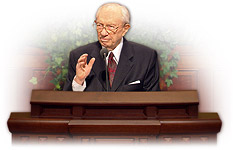
Gordon B. Hinckley at PulpitIn the June 2007 Ensign, Seventy Jay Jensen and Apostle Jeffrey Holland, both of whom are LDS General Authorities, provided this exchange on page 96:

Elder Jensen: So far our discussion has concentrated on the four standard works. We do have other scripture.
Elder Holland: Yes. Do you want to say a word about the living prophets?
Elder Jensen: We do have good manuals, and we do have magazines and stories. Aren’t they powerful?
Elder Holland: We do have great material, to say nothing of the whole world of the living prophets and semiannual general conference broadcasts and publications that go to the Church. We have a wealth of the word of God available to us, and we ought to use it.
LDS Gospel LibraryNotice what Jensen said: “We do have other scripture.” According to these GAs, the “other scripture” sources come through manuals, conference speeches, and other official church materials. Yet how often have I quoted from these sources and then been rebuffed because it’s different from what an individual Mormon might believe?

But let’s turn the tables. Why should I accept the Mormon’s individual interpretation about a particular doctrine as authoritative unless it can be fully supported by her scripture? Too often Christians let the Mormon off the hook—“after all,” we think, “she’s the Latter-day Saint and I’m not”—when the burden of proof should be placed upon individual Mormons. Let them support their beliefs by making reference to the authoritative words of the church and not just basing their ideas on feelings or what they feel is common sense. If I’m wrong, then show me; for example, did I take a particular teaching or quote out of context? But to say that I am not explaining Mormonism in an accurate manner merely because it’s different from a particular Mormon’s personal belief system is, as a friend of mine once termed it, “poppycock.”

Based on the above words of the two GAs, I don’t think it’s possible that the ideas of Mormonism belong to an esoteric postmodern camp. If so, then the only person who can truly follow this faith the way it was meant to be followed is each individual Latter-day Saint and the use of his or her own interpretation skills. If this is true, maybe the Mormon Church can save itself some time and money by no longer hosting conferences or producing its material for the membership. The church should then declare that its followers can interpret Mormonism any way they wish, just as long as they call themselves Mormons and pay their tithes.

I have a sneaking suspicion, however, that the leadership in Salt Lake City will never be willing to preach such a radical message from the conference pulpit. And think about it. Even if President Hinckley decided to turn this idea into doctrine, why should anyone accept it anyway? Quite the vicious circle, isn’t it?

104 Comments so far

  1. Daniel on June 21st, 2007

    As my good friend Aaron always says, it’s like nailing jello to a wall…

  2. rick b on June 21st, 2007

    We read J Smith saying in the book History of the Church vol 4, pg 461. “I told the brethren that the Book of Mormon was the most correct of any book on earth, and the keystone of our religion, and a man would get nearer to God by abiding by it’s precepts, than any other book.”

    Then over in the book, Teachings of the prophet Joseph Smith on pg 71 we read, ” Take away the book of Mormon and the revelations, and where is our religion? we have none.”

    Now lets look at what the prophet, Joseph Fielding Smith said. Notice Joseph Smith was the first “prophet” Joseph F Smith was the 10th “prophet/president” of the Church. So as not to confuse with the close names.

    We read in the book,

    Doctrines of Salvation vol 3, pg 198-199 J.F.S. teaches, ” In my judgment their is no book on earth yet come to man as important as the book known as the Doctrine and Covenants, with all due respect to the Book of Mormon, and the Bible, and the pearl of great price, which we say are our standerds in Doctrine. The book of Doctrine and Covenants to us stands in a peculiar postion above them all.

    I am going to tell you why. When I say that, do not for a moment think I do not value the Book of Mormon, the Bible, and the Pearl of Great Price, just as much as any man that lives; I think I do. I do not know of anybody who has read them more, and I appreciate them; they are wonderful; they contain doctrine and revelation and commandments that we should heed; but the Bible is a history containing the doctrine and commandments given to the people anciently. that applies also to the Book of Mormon. It is the doctrine and history and commandments of the people who dwelt upon this continent anciently.

    But this Doctrine and Covenants contains the word of God to those who dwell here now. It is our book. It belongs to the Latter Day Saints.

    So we find here two prophets who disagree on just how important the BoM really is?

  3. rick b on June 21st, 2007

    This goes along with what I posted above, I had to many words so I am adding a second part. This shows 3 Prophets who cannot agree.

    If they cannot agree on their own Doctrine, How can I trust them to tell me or show mwe the truth?

    Now lets add to this what Ezra Taft Benson taught. He taught the 14 fundamentils of following the brethern. This was the SECOND: The Living Prophet is More Vital to Us Than The Standard Works.

    So now we have 3 people, all prophets teaching different things. This leads to another question, if D and C is over the book of mormon, why do the Mormon missionary’s not pass that out? And if the Prophet is over all the 4 standered works, why bother passing them out at all? Why not pass out books of the prophets teachings?

    The fact that they cannot agree, might explain why some LDS here cannot answer certain Questions, Because their prophets cannot agree on the answer. Rick B

  4. Arthur Sido on June 21st, 2007

    Quite frankly that whole “Don’t tell me what I believe, ask a mormon if you want to know what mormons think” is a dodge used when a mormon is faced with witnessing from someone who is more than marginally familiar with mormon doctrines. They can’t be explained in light of the Bible nor by plain common sense, so the only other ways to go are to agree that they are made up or to claim misrepresentation.

    If Joseph Smith was a prophet, then it follows that when he spoke clearly and definitively on matters of theology and doctrine, that should be seen as authoritative. The same is true for Brigham Young, Joseph F. Smith, Gordon Hinckley or really any general authority. These men are affirmed as specially endowed revelators of God’s will at every General Conference and their teachings are widely recorded and published. By being a mormon, one tacitly agrees to be held under mormon authority and teachings. No one who sits under my pastoral care is required to hold to the exact doctrines I do, nor am I under obligation to follow in lockstep with the Southern Baptist Convention. But mormons are required to recognize and submit to the priesthood authority hierarchy and as such are required to believe what Salt Lake says.

  5. losingmyreligion on June 21st, 2007

    I think one of the things I am choking on right now is this belief that the church leadership is the Authority and I am to submit myself to them. I know this is one of the 7 deadly sins for a mormon, to question “the brethren” but my authority is God and Christ and no other.

    Thank you for your blog. It helps.

  6. Arthur Sido on June 21st, 2007

    LMR,

    That is one of the things accomplished on the cross, removing the need for a human intercessor between man and God. No human, whether a real prophet like Moses or a false one like Joseph Smith, can truly bridge the chasm between man and God. Only the One who has both fully man AND fully God could do that. Anyone who tries to interpose themselves between man and God now, post-cross, whether prophet or pope, denies one of the keys of the cross of Jesus Christ.

    I know first hand how hard it can be to extricate yourself when you have had ingrained into you to put your trust in the church authorities, but the freedom I have found in Christ makes every struggle worth it.

  7. Ruthie on June 21st, 2007

    LMR,

    Asking questions is a good thing. The truth can withstand investigation–it won’t run, it won’t fade, it won’t change. The truth is the truth . . . and I am so grateful that you are asking questions and that you want to know the truth. That, dear friend, is one of the first steps in being set free from spiritual bondage. I’m sure you’ve heard “The Truth will set you free,” and I’m here to tell you that I’m a living example of that!

    LMR, I hope you will continue to ask questions and continue to investigate until you find the Truth (John 14:6). It’s worth it.

  8. john f. on June 22nd, 2007

    When Jensen said So far our discussion has concentrated on the four standard works. We do have other scripture, it is possible that he meant the sentence “We do have other scripture” as a reference to the content of the four standard works, i.e. that it was a statement meant to confirm the fact of the three of the standard works that Latter-day Saints have in addition to the Bible.

    At any rate, Latter-day Saints do not believe that the lesson manuals and such materials are scripture.

  9. Qahal on June 22nd, 2007

    Arthur, I find it slightly inconsistent that under a post that takes a jab at Mormon tendencies to individualize doctrine, you take a broad jab at any form of Church authority. I don’t see that as being all that helpful. Christianity is not a collective group of anarchists. It doesn’t reject all forms of authority, nor does a form of Church authority have to conflict with a relationship with Christ or with the authority of Scripture. For example, the Pope is not my redeemer, nor is he a mediator between myself and God. He is the primary defender and protector of God’s truth, in my mind. You are free to reject that all you want, but your statement above does not characterize it correctly.

    The problem isn’t authority IN GENERAL, but that Mormonism presents a false authority. LMR, I would feel cheated if I was submitting to a false authority as well. This ministry does a FANTASTIC job of highlighting all of the reasons why Mormonism is a false authority. It is consistently inconsistent. The common attitude as described above is a byproduct of Mormon gnosticism. Not only can Mormons not answer many questions about their doctrine, but how could we non-Mormons possibly comprehend the “depths” of their “truths”? It is smoke and mirrors. They submit to Salt Lake and yet they are each an authority unto themselves. I personally believe that this is a consequence of their understanding of the afterlife and what it means to be human. After all, if those who are “worthy” are destined to be gods like the Father, isn’t it reasonable to suspect that such a belief would create the type of egoism and individualism that we regularly witness?

    Keep up the good work.

  10. Eric on June 22nd, 2007

    Obviously Jensen was not saying that these magazines and manuals comprised a fifth standard work. I never inferred this in the article. The point is, however, that the teachings of the LDS leaders are supposed to be treated AS scripture, and therefore they are completely authoritative for the LDS people. Without having anyone with special authority to tell them how to believe/act/etc., the Mormon people would be lost because–while the males do hold the “priesthoods”–the authority to interpret the otherwise dead scriptures belongs to GAs. This is why Mormons annually vote to sustain these men at general conference. The membership has voluntarily given them this role. And that’s the point of the article: Just how can a person determine what is Mormon doctrine? But I disagree with John’s analysis since the context shows Jensen was obviously NOT referring to the four standard works when he used the term “other scripture” in this interview, which if it means anything, came in an official church publication. You would really have to read into this quote to come up with analysis saying otherwise. But if Mormonism can be determined by a person’s own analysis of what Jensen said–meaning that the Mormon’s belief contains more weight than the beliefs of the general authorities–then none of this matters anyway. We’re left with each individual’s opinion, and thus, why do we need the church leaders at all to teach us from the pulpit? Just read the standard works for yourself and come up with your own conclusion, even if it contradicts the GAs.

  11. john f. on June 22nd, 2007

    The canonization process is not to be overlooked in discussion of what is and is not LDS scripture. Luckily this process exists and any teaching or writing that is to be scripture must go through that process.

    An argument exists that only material in the Standard Works are scripture for Latter-day Saints. The Church itself supports this view, as described in a recent press release: http://www.lds.org/ldsnewsroom/v/index.jsp?vgnextoid=970af549db852110VgnVCM100000176f620aRCRD&vgnextchannel=f5f411154963d010VgnVCM1000004e94610aRCRD

    The press release notes the following:

    Not every statement made by a Church leader, past or present, necessarily constitutes doctrine. A single statement made by a single leader on a single occasion often represents a personal, though well-considered, opinion, but is not meant to be officially binding for the whole Church. With divine inspiration, the First Presidency (the prophet and his two counselors) and the Quorum of the Twelve Apostles (the second-highest governing body of the Church) counsel together to establish doctrine that is consistently proclaimed in official Church publications. This doctrine resides in the four “standard works” of scripture (the Holy Bible, the Book of Mormon, the Doctrine and Covenants and the Pearl of Great Price), official declarations and proclamations, and the Articles of Faith. Isolated statements are often taken out of context, leaving their original meaning distorted.

    Despite this clear understanding, shared by many Latter-day Saints, of what is actually scripture, most active Latter-day Saints honor the spoken word of the prophet and apostles and treat it with high deference out of respect for them and out of a belief that they are inspired in the direction they give the flock.

  12. rick b on June 22nd, 2007

    John F. This is what your Prophet said and taught, and this contradicts what you posted, So Do I trust you, or your Prophet?


    In conclusion, let us summarize this grand key, these “Fourteen Fundamentals in Following the Prophet,” for our salvation hangs on them.

    First: The prophet is the only man who speaks for the Lord in everything.

    Second: The living prophet is more vital to us than the standard works.

    Fourth: The prophet will never lead the Church astray.

    Sixth: The prophet does not have to say “Thus saith the Lord” to give us scripture.

    I testify that these fourteen fundamentals in following the living prophet are true.if we want to know how well we stand with the Lord, then let us ask ourselves how well we stand with His mortal captain. How closely do our lives harmonize with the words of the Lord’s anointed–the living prophet, the President of the Church, and with the Quorum of the First Presidency?

    I would like to point out, that the prophet Makes the claim all this is true And that OUR/YOUR SALVATION DEPENDS UPON THEM. So if any LDS state this stuff is not true, remember, we have a serious problem. The problem is, you saying the Prophet is and has taught lies? Rick B

  13. john f. on June 22nd, 2007

    Ezra Taft Benson’s talk is very important and expresses why Latter-day Saints hold their prophet in such high regard. A good comparison might be to imagine living at the time Jeremiah was alive and preaching to get a sense of how Latter-day Saints honor and follow the prophet.

    On the other hand, the canonization process exists for a reason. There is a reason that anything that is to be regarded as scripture on par with the Standard Works must be put to the entire body of the Church. This must not be overlooked when trying to explain to Latter-day Saints what they believe.

  14. Interested on June 22nd, 2007

    John
    Tell me why your prophet would say The prophet does not have to say “Thus saith the Lord” to give us scripture.? That sounds like everything he says is scripture.

  15. Alex D. on June 22nd, 2007

    John,

    If what Interested wrote was true (and it is true, for it came from the pulpit of an LDS Prophet), then how are we to determine when one (who has the ability to canonize doctrine in your Church) is speaking for the Lord or for himself? This (I’m sure) is what everyone here would like to know.

  16. rick b on June 22nd, 2007

    John said On the other hand, the canonization process exists for a reason.

    Two things John,
    1. Ezra Taft Benson, The Prophet, Not me or some non-LDS, But the Prophet said, Your salvation depends upon believing what the Prophet said.

    2. If Ezra was wrong, can you tell me why and how he was wrong? If he was why has no LDS corrected him on this matter? Your not a Prophet, your sources are not from the living prophet, spoken by him, So How can I trust you? If I cannot trust your Prophet, how can I trust anything your prophets ever spoke about?

    P.S, Neil, Still waiting for reply to 3-4 subjects, you said, I promise Keith walker, I will return and answer this, no replys yet. Was my felling correct as I said before? If you cannot answer these questions, in the light of the fact you said you would and could, how can you be sure your saved. You cannot even answer simple questions. Rick b

  17. john f. on June 23rd, 2007

    Each of the 14 fundamentals given by Ezra Taft Benson in his 1980 talk to BYU students is accompanied by explanatory gloss in that same talk. Benson’s statement that “the living prophet is more vital to us than the Standard Works” hinges on the word “vital” because, as the explanation that follows the statement shows, it deals with issues affecting and unique to modern or current life and the existence of the Church.

    Benson explained this fundamental with reference to an experience in the early Church where a man challenged Joseph Smith and the leaders of the Church that when they gave revelations, they should “confine” themselves to what is written in the Bible, the Book of Mormon, and the Doctrine and Covenants — that is, the content of any revelation should be nothing more than reiteration of what is in those books of scripture. Although this approach has a certain appeal because it removes the requirement of trusting ecclesiastical leaders, Joseph Smith deferred to Brigham Young to answer the challenge. In 1897, approximately 60 years after this episode in Kirtland, Wilford Woodruff related that Brigham Young’s answer was to point out that even though the scriptures contain the word of God and the truth of God, they often do not (and as a matter of common sense simply cannot) speak to spiritual and temporal circumstances that currently face God’s people. Benson added the following useful example:

    God’s revelation to Adam did not instruct Noah how to build the Ark. Noah needed his own revelation. Therefore the most important prophet so far as you and I are concerned is the one living in our day and age to whom the Lord is currently revealing His will for us.

  18. john f. on June 23rd, 2007

    Benson is teaching a principle of common sense. An example would be the modern prophets’ counsel to maintain one-year’s food storage. That admonition does not appear in the scriptures but Latter-day Saints believe it is precisely the type of admonition and warning that God communicates to his people through a prophet. Benson is not speaking in terms of Gospel truths when he states that the modern prophet is “more important” than past prophets (he would not have held that his words regarding the truth and power of the Atonement were more important than Isaiah’s or Paul’s, for example) but rather in terms of practical living.

    Benson’s fundamentals do not change or ignore the canonization process for adding material to the scriptures. The process includes achieving unanimity among the Brethren about a certain statement or doctrine and then once such unanimity is achieved, putting the statement or doctrine to the entire body of the Church for a sustaining vote.

  19. Eric on June 23rd, 2007

    John, the question at hand is, are the prophets’ words to be believed or not? Are they to be heeded as words given to us by men who were sustained as leaders appointed by God? Forget about their words being scripture. The point is, are the GAs authoritative or not? Suppose a member (with full priesthood authority) has a contrary opinion on doctrine, right living, etc. Who should I believe is the one teaching truth? The laymember? Or the GA? Or is it orthodox to allow everyone figure it out for themselves?

  20. rick b on June 23rd, 2007

    John, I read all 14 given plus the Scripture used to support them, I could not post them because of a word limit.

    You still have not really answered the question.
    My points are, Benson did say, our salvation hangs upon them That does not imply good advive, that implys they are serious, then the Issue of, the Prophet does not need to say Thus saith the LORD to give us scripture is a problem.

    I have told LDS before, If you agree, it is scripture, if you dont agree, it’s not scripture. 2 examples to show both.

    1. Brigham Young said the Adam God Doctrine is both Scripture and Doctrine. Yet you guys deny it.

    2. King Follet Discourse. Much of todays LDS doctrine is taken from that, and you guys look at it as Joseph Smith greatest sermon ever Given.

    Why are both found in the JoD, both by LDS prophets, yet one loved and one hated. One is less than 2 pages, the other is 11 pages, yet the 2 page Adam God, is said to be written down incorretly and flawed, yet not the 11 pages written by the same scribe. That to me proves my point. Rick b

  21. john f. on June 23rd, 2007

    Latter-day Saint prophets have, since the beginning, and particularly with Brigham Young, challenged all who hear their words to seek individual confirmation from God whether those words are inspired or not. Thus, while giving high deference and respect to General Authorities and especially the prophet because of a belief in living prophets, Latter-day Saints can and should figure out for themselves what is the right way to live and whether the words spoken by General Authorities should be the guide in a specific circumstance. There will always be exceptions. LDS Apostle Dallin H. Oaks recently said in a General Conference address that the General Authorities often do not deal with the exceptions because they are to guide the Church but that if a person feels like they are an exception, then they probably are.

  22. John C. on June 23rd, 2007

    A question:

    How does one come by the authority to make authoritative statements in Evangelical circles? In some cases, I know that some training in a divinity school is important, but there does seem to be a serious lay element influential in Evangelical theology (of course, I say that looking from the outside in). By what notion is your concept of canonization more correct than ours (I being LDS)?

    If there is a burden of proof to determining who bears the authority to interpret and reveal scripture, isn’t it borne just as heavily by the Evangelicals as it is borne by the Mormons?

  23. rick b on June 23rd, 2007

    John F said Latter-day Saint prophets have, since the beginning, and particularly with Brigham Young, challenged all who hear their words to seek individual confirmation from God whether those words are inspired or not.

    John, a few problems here with what you said. If I say I sought God about what LDS church says and teaches, And I claim God told me it’s all lies, then you will or might say, I was not sincere or I really did not hear from God. Then this goes against what Ezra Benson said, the Prophet CANNOT LEAD THE CHURCH ASTRAY. If thats true, I should not need to seek the Lord on this matter.

    Then Ezra taught, the PROPHET SPEAKS FOR THE LORD IN EVERYTHING. If thats true and I then seek the Lord to know if this is true, I am not trusting God by saying I dont believe in His prophet and need to seek Him on a subject He spoke to me about through His prophet.

    Then we have Acts 17:11, It says search the Scriptures to know if these things are true, And the Bible tells us to Test ALL things, Not simply believe all things. And the Bible tells us Satan can come in the form of an angel of light to decive, So how can I tell if I am being decived by an angel? Your reply is very flawed and devoid of logic. Rick b

  24. John C. on June 23rd, 2007

    Rick,
    No one is arguing that you shouldn’t test things. If the Lord told you that the LDS church is full of lies, I’m not going to argue with you. But how do you know that you’re not being deceived by an angel of light and that I’m not right? Your questions can just as easily be turned on you.

    For my part, I believe that the Lord told me the LDS church is full of truth. So, if we accept that we are both sincere seekers of the truth, then we have a contradiction (assuming that either your or my understanding of the truth is sufficiently correct, which I may disagree with (by which I mean that I don’t believe that I have the whole truth)).

  25. John C. on June 23rd, 2007

    Also, people who rely on a modern interpretation of a two-thousand year old book while simultaneously arguing that this modern interpretation is the definitive interpretation of the two-thousand year old book should not call other people’s arguments illogical. Glass houses and all that.

  26. rick b on June 23rd, 2007

    John C said Also, people who rely on a modern interpretation of a two-thousand year old book while simultaneously arguing that this modern interpretation is the definitive interpretation of the two-thousand year old book should not call other people’s arguments illogical. Glass houses and all that.

    A few things on this, 1. it is 66 books by 40 authors written over 1000’s of years, it’s not simply One book.

    2. it says many Times it is the WORD OF GOD.

    3. Their is overwhelming evidence to support the book as fact.

    Then the issue you raised with my reply to John f, is still lacking, He said his prophets are true and correct, yet we cannot trust them because when we quote them were told we can only use the 4 standerd works, the whole point of this topic was, how can we trust what is said by the prophets if only the 4 standerd works are to be accepted as Gods word only. Then LDS dont fully trust the Bible, so if you come to the Bible not fully trusting it and Find it flawed, A of F 8, then you have a problem before you even read it. And if you cannot fully trust it as Gods word, why quote from it? Rick b

  27. John C. on June 23rd, 2007

    Come now, Rick. Surely you don’t expect me to take the word of the book (or books) alone. Why the Book of Mormon claims to represent the word of God and you wouldn’t want me to accept that on face value either, right?

    Second, the issue isn’t why I should accept the Bible (indeed, I believe that I do an excellent job of accepting the Bible), but rather why I should accept your interpretations of the Bible (or Evangelical interpretations, if you prefer). Can you give me a logical reason to prefer your interpretation to my own or my prophets’?

    Rick, I am confused. I don’t have a clue what you mean by trust in this sense. Could you elaborate a little further?

  28. Geoff J on June 23rd, 2007

    3. Their is overwhelming evidence to support the book as fact.

    Wait… Are you talking about the Holy Bible here?

  29. Eric on June 23rd, 2007

    John F says: “Latter-day Saints can and should figure out for themselves what is the right way to live and whether the words spoken by General Authorities should be the guide in a specific circumstance.”

    So, I ask, John, do you have any evidence (outside your own conscience/sense of right and wrong) that what you say is correct? Is your view of Mormonism so Post-Modern that you consider yourself the final determinating factor as to what is correct and what is not? (Do you have any documentary evidence where your leaders say that their words should be superseded by individual Mormons?)

    If so, then why do you need “Latter-day” revelation? Why wasn’t a person’s own interpretations valid before the days of Joseph Smith? And did the Church really need a restoration?

    As far as John C’s comment: “If there is a burden of proof to determining who bears the authority to interpret and reveal scripture, isn’t it borne just as heavily by the Evangelicals as it is borne by the Mormons?” the answer is no. Evangelicals don’t pay homage to a group of human leaders (other than Christ, 1 Tim. 2:5) who tell them what is and is not truth. Rather, Christians have been given the royal priesthood and can determine truth from the Living Book that, when interpreted properly, divides between bone and marrow and is a light in a dark world. It is the Word of God, and while Latter-day Saints may pay lip service to the Bible, too often I have personally been told that they would rather believe Joseph Smith and their leaders over this “antiquated” set of 66 books. To me, that’s most troublesome indeed. Rick brings out a good point: If you cannot fully trust it as God’s word, why quote from it?” I take it one step further: If it really is not trustworthy, then the very idea that James 1:5 influenced Smith to pray about truth and receive a “First Vision,” how can I really trust any of this then? Such a vicious circle when you start to flame one of your own scriptures.

  30. John C. on June 23rd, 2007

    First of all, I already posted a reply to Rick B’s comments. Could someone release that from moderation?

    Second, Eric, I am fascinated by the distinctions that you are drawing.

    “Evangelicals don’t pay homage to a group of human leaders (other than Christ, 1 Tim. 2:5) who tell them what is and is not truth.”

    Let’s set aside the question of the humanity of Christ, which has certainly been a subject of dispute in Christian history, and focus on the other point. Aren’t there founders for the modern Evangelical movement? William Jennings Bryan comes to mind? Perhaps Billy Graham? Don’t you respect the opinions of these men and give them careful consideration? Perhaps you don’t call them prophets, but you certainly pay them homage. Maybe you mean something by homage that I don’t. Could you explain what you mean?

    Second, there have always in Mormonism been paradoxical trends. Some groups within Mormonism argue like President Benson. Others argue like President Young. As a member of the broad Protestant movement, you should be used to competing approaches to scripture and revelation. Why is the realization that such also exists in Mormonism shocking?

    “Rather, Christians have been given the royal priesthood and can determine truth from the Living Book that, when interpreted properly, divides between bone and marrow and is a light in a dark world”

    What do you mean by royal priesthood? What do you mean by proper interpretation? Why should I believe that you have the royal priesthood and I don’t? What gives you the authority to determine the appropriateness or inappropriateness of my view? How do you know that you are interpreting correctly and I am not?

    No-one is flaming any scripture. I think that one of the basic disconnects that we are dealing with here is that you believe that Mormons pick and choose scriptures, while Evangelicals do not. We all do it. There is a reason why slave owners and abolitionists both found justification in the Bible.

  31. john f. on June 24th, 2007

    As far as John C’s comment: “If there is a burden of proof to determining who bears the authority to interpret and reveal scripture, isn’t it borne just as heavily by the Evangelicals as it is borne by the Mormons?” the answer is no. Evangelicals don’t pay homage to a group of human leaders (other than Christ, 1 Tim. 2:5) who tell them what is and is not truth.

    This statement makes it sound like the claim is that your view of Evangelicalism is so Post-Modern that you consider yourself the final determinating factor as to what is correct and what is not.

    On the other points raised:

    - Latter-day Saints fully believe in the Bible and do not merely pay lip service to it.

    - Latter-day Saints trust the Bible as God’s word and live their lives according to it.

    - Latter-day Saints give equal weight to Romans and James in their appreciation of the Bible and do not flame James the way that Martin Luther did when he dismissed it intellectually as “an Epistle full of straw” (”eine stroherne Epistel“) and did not consider it scripture because James was inconsistent with Martin Luther’s own interpretation of Romans 3:28, a doctrine of Paul which ML preferred over the doctrine found in James. It is a vicious cycle when one must reject one book of scripture that is found in the Bible in order to elevate the doctrine of another book found in the Bible.

  32. RoastedTomatoes on June 24th, 2007

    As a simple matter of necessity, it is impossible for a Latter-day Saint to really believe everything that church leadership has ever said, for the simple reason that the body of statements in question contains a range of contradictions. On the issue at point, Benson has been quoted saying that the current leader supersedes anything else, including the scriptures. Fine. Here’s a quote from Harold B. Lee during the period when he was the president of the LDS church:

    I say that we need to teach our people to find their answers in the scriptures. If only each of us would be wise enough to say that we aren’t able to answer any question unless we can find a doctrinal answer in the scriptures! And if we hear someone teaching something that is contrary to what is in the scriptures, each of us may know whether the things spoken are false—it is as simple as that. But the unfortunate thing is that so many of us are not reading the scriptures. We do not know what is in them, and therefore we speculate about the things that we ought to have found in the scriptures themselves. I think that therein is one of our biggest dangers of today (Harold B. Lee, Ensign, Dec. 1972, p. 3).

    Lee says that statements in contradiction of the scriptures — by anyone, leadership included (note the “we”) — “are false-it is as simple as that.” Can you believe both this and what Benson said? Probably not. But Latter-day Saints are surely free to believe either within the confines of the church, because the highest leadership of the church has taught both ideas.

  33. Eric on June 24th, 2007

    John, you said: “Aren’t there founders for the modern Evangelical movement? William Jennings Bryan comes to mind? Perhaps Billy Graham? Don’t you respect the opinions of these men and give them careful consideration? Perhaps you don’t call them prophets, but you certainly pay them homage. Maybe you mean something by homage that I don’t. Could you explain what you mean?”

    I don’t call these godly men “prophets.” They’re teachers, but I base what they say on the Word of God. Do Mormons really do the same? What if, in a fast and testimony time, you got up front and said, “You know, what the apostle said in the last conference really wasn’t scriptural.” How would that go over?

    John C. said: “What do you mean by royal priesthood? What do you mean by proper interpretation? Why should I believe that you have the royal priesthood and I don’t? What gives you the authority to determine the appropriateness or inappropriateness of my view? How do you know that you are interpreting correctly and I am not?”

    1. 1 Peter 2:9
    2. Proper interpretation: determining what the author meant to the people of His day and contextualizing it for meaning today, but not different in the original message.
    3. Christians have the royal priesthood, and the man Jesus Christ mediates between us and God.
    4. In which passage are you referring? There is a correct way to determine the meaning of a passage, and there are many false meanings.

    John C. said: “We all do it. There is a reason why slave owners and abolitionists both found justification in the Bible.”

    The goal is to “not do it.” Saying “we all do it is meaningless.” As your example shows, either slavery was justified or it was not. You can’t argue for both being true at the same time.

  34. John C. on June 24th, 2007

    “There is a correct way to determine the meaning of a passage, and there are many false meanings.”

    Excellent. Please explain it to me. I would love to understand it.

  35. Bill McKeever on June 24th, 2007

    “And if we hear someone teaching something that is contrary to what is in the scriptures, each of us may know whether the things spoken are false—it is as simple as that.”

    So much then for the Priesthood revelation of 1978. “I know of no scriptural basis for denying the Priesthood to Negroes other than one verse in the Book of Abraham (1:26)” (President David O. McKay cited in The Church and the Negro, p.91).

    Oops.

  36. Eric on June 24th, 2007

    John C., are you serious that you would “love to understand” how to properly interpret scripture? (If I was a skeptic, I would think you were being sarcastic.) But for the sake of fairness, I’ll assume you are sincere. Well, then, allow me to suggest a primer, and using simple tools, you too can discover the meaning of the Bible. Called How to Read the Bible for All its Worth, this simple-to-understand book explains how to properly take the Bible and interpret using inductive methods (i.e. understanding the history, background, peoples, cultures, etc of the people of the day the book was written). You don’t need others to interpret for you; here’s a link. Why not give it a shot? The Bible has meaning for us today!
    http://www.amazon.com/How-Read-Bible-All-Worth/dp/0310246040/ref=sr_1_1/002-1480820-4582447?ie=UTF8&s=books&qid=1182738960&sr=1-1

  37. Geoff J on June 25th, 2007

    Eric: You don’t need others to interpret for you; here’s a link.

    Wait, if we don’t need others to interpret the Bible for us why are you giving a link to a book designed to tell us how to interpret the Bible? Further, if it is so easy for anyone to interpret the Bible then why are there so many different interpretations of the meanings of the various passages in the Bible even among Christians?

    Most people agree that ultimately “There is a correct way to determine the meaning of a passage, and there are many false meanings” — the disagreements are over what exactly is the correct way to do determine the correct way.

  38. Alex D. on June 25th, 2007

    Geoff,

    Wouldn’t you say that a “correct” interpretation of a Biblical passage would have to meet the following criteria as Eric (and the book) mentioned “(i.e. understanding the history, background, peoples, cultures, etc of the people of the day the book was written)?” It goes without saying that an informed interpretation (i.e. one brought forth through scholarship) would prove to be more correct than taking a passage at face value.

    As for there being “many different interpretations of the meanings of the various passages in the Bible… among Christians,” you have to take into consideration the fact that the Lutherans and the Baptists (for example), while being two Christian denominations, are still two different denominations for a reason; that goes for the rest of the Christian denominations as well.

    Sure, it’s “easy for anyone to interpret the Bible,” but that can be said about anything (i.e. It’s not hard to interpret something, but it IS hard to have 100 people interpret something and have them all arrive at the exact same conclusion… much less millions of Christians worldwide for that matter).

    The beauty of great art is its ability to touch each person that views it in a similar but nonetheless different way. The same may be said of the Bible. However, you must admit that, while there are many different conclusions to arrive at, some are just plain wrong. The book does not dictate what one should believe about a particular passage but instead provides a set of guidelines for the reader to follow. These guidelines, when properly followed, do not lead the reader to one conclusion only; on the other hand, they are merely to give the reader an informed background when that time finally comes to tackle a specific passage. It’s still possible for two people (who have read that book and follow it’s guidelines) to still have differing opinions, but they’ll at least be able to say that their opinions are supported by fact.

  39. john f. on June 25th, 2007

    John C. is a Ph.D. candidate in Hebrew Bible and Bible Studies at Johns Hopkins University, if I may be so bold as to mention a point about his background. In other words, when he stated that he would “love to understand” how to properly interpret scripture, he was expressing his incredulity at simplistic explanations offered here. I am skeptical that the primer given as a resource will prove beneficial to him. Perhaps he is looking for more of a discussion from those who run this blog on why they would prioritize certain interpretations of scripture over others.

  40. Eric on June 25th, 2007

    Alex is correct. Geoff, notice the book I referred doesn’t tell the reader about the proper interpretations of any particular passage. Rather, it shows you how a person can make proper interpretation based on the passage itself. Your objection is rather shallow. Let me ask, how would you propose I:

    * determine just what’s wrong with my car unless I use the tools provided me to test the car and see just what is making that rattling noise so I can fix it?

    * solve a math problem unless I utilize the proper formulas for the particular question at hand?

    * make a diagnosis as a doctor unless I use the tools taught to me in medical school on how to observe the symptoms and then make a proper diagnosis? And what do I do when I have been diagnosed with “Ankylosing spondylitis”? If I go up to someone on the street with no medical know-how and ask, “How do I treat my disease?” what if the person says “through Robitusin PM.” Now, that’s great advice…if you have a cold. But my disease is different. The proper way to deal with “Ankylosing spondylitis” is through a long-term treatment of physical activity and anti-inflammatory drugs. Wouldn’t you rather get advice from someone who understood the tools of medicine rather than someone who merely gave it their best shot?

    The examples could go on and on, but there is not a “simple” procedure in determining the proper interpretation for a passage. But unless one uses hermeneutic tools in a proper manner, you are bound to come up with any willy-nilly interpretation, and how would you know it was wrong? If you base it on “feelings” and “it just seems to make sense,” you’re bound for error. I’d rather do the homework and make an interpretation based on accuracy rather than likes and dislikes or merely to satisfy my presuppositions.

  41. Geoff J on June 25th, 2007

    Eric and Alex,

    If it makes you feel any better, I am all for rigorous Biblical scholarship. Based on Eric’s comments earlier I wasn’t so sure he was as well. I’m glad to learn you don’t hold a overly simplistic view on the subject of Biblical hermeneutics though.

  42. John C. on June 25th, 2007

    Wow, comments are multiplying quickly today. I’ll do what I can to keep up.

    Eric, I’ve looked over the piece of the preface of that book that they have in Amazon. It looks good to me. They preach skepticism of certainty, which is appropriate in approaching a book (or group of books) that was developed in a groups of societies and cultures that were fundamentally different from our own. As they note, while the Bible is the eternal word of God, we have received it through human intermediaries who discussed it in the historical context with which they are familiar. This should caution us against assuming that we know “the” interpretation. There is a vast gulf between us and those human intermediaries.

    I also often believe that plain readings are the best, but there are, as the authors of that book note, exceptions. I will try and find the book at the local library and give it a skim. It looks good to me; if it had been written by LDS scholars, I don’t think very much in the preface would read differently (for what its worth).

    I didn’t offer proper responses to your earlier remarks, so please allow me…
    “I don’t call these godly men “prophets.” They’re teachers, but I base what they say on the Word of God. Do Mormons really do the same? What if, in a fast and testimony time, you got up front and said, “You know, what the apostle said in the last conference really wasn’t scriptural.” How would that go over?”

    Well, biblically speaking, prophets teach a lot and prophesy occasionally. I don’t know the last time one of our prophets actually said something ascriptural (I am curious as to what you mean by that), but I personally wouldn’t mind saying that in fast and testimony meeting. I would follow it with a testimony of the importance of modern scripture, modern prophets, and an open canon, but, then again, I am a Mormon. In case you haven’t noticed, we are of two minds on this issue (and we seem to like it that way).

    Oops, I’m out of room. More later……

  43. Aaron Shafovaloff on June 25th, 2007

    Of the two positions that Geoff mentioned (prioritizing what prophets have said over scripture or vice versa) I think most Mormons, in practice, selectively choose one or the other based on the issue at hand. And as Eric pointed out, the notion of canonized “scripture” is itself problematic in Mormonism, as it sometimes refers to the standard works, and sometimes more.

    It’s indeed like nailing Jello to the wall. I’ve come to the conclusion that submitting to living priesthood authority leadership is ultimately more important to Mormons than knowing and submitting to the truth. I think a great illustration of this attitude is the historic interaction between Orson Pratt and the other apostles when they were trying to get him to submit to Brigham Young over issues like Adam-God. They were more concerned that Orson submit to Brigham than with Brigham being actually right about the issues at hand (even those concerning the nature of God). I don’t think much has changed.

  44. john f. on June 25th, 2007

    I’ve come to the conclusion that submitting to living priesthood authority leadership is ultimately more important to Mormons than knowing and submitting to the truth.

    The premise that Aaron sneaks into this statement is that LDS priesthood authority is not or does not represent truth. That is a matter of belief. Latter-day Saints view the matter differently than creedal Christians (obviously).

    It is true that Latter-day Saints are perhaps relatively (although not entirely) unique in submitting to the authority of their priesthood leaders (in other words, in giving high deference to the words of the Prophet and possibly the Apostles and possibly even feeling obligated to obey those words because of their source). Latter-day Saints are perhaps unique in this regard because the track record is for people to cast out, reject, and kill their prophets. Gordon B. Hinckley can be thankful that Latter-day Saints do not treat him the way that Jeremiah’s audience treated him. Rather than cast our prophets out, we accept their word and honor them, all the while realizing that they are only messengers of Jesus Christ and not objects themselves of adoration or worship of any kind. Life in the early Church subject to the physical leadership of Peter, James, and Paul would not have been much different, although the concept that Apostles no longer play any role in Christ’s living Church is certainly appealing since it removes an aspect of faith that requires disciples of Jesus Christ to trust his servants.

  45. Daniel on June 25th, 2007

    “I think a great illustration of this attitude is the historic interaction between Orson Pratt and the other apostles when they were trying to get him to submit to Brigham Young over issues like Adam-God. They were more concerned that Orson submit to Brigham than with Brigham being actually right about the issues at hand (even those concerning the nature of God).”

    I think that what Aaron is getting at here, is that multiple sources of special revelation exist in the LDS church, some of which have contradicted each other. In such instances, who is right, the prophet, or the scriptures? Or what if the current prophet contradicts what a previous prophet said (see Rick B’s posts above)? What appears to be the precedent is that the flock blindly follows the shepherd, without looking at a roadmap to see if the direction the shepherd is going is correct.

  46. Aaron Shafovaloff on June 25th, 2007

    “The premise that Aaron sneaks into this statement is that LDS priesthood authority is not or does not represent truth.”

    You’re missing the point, John. Many Mormon apologists, historians, and bloggers have come to the realization that the prophet Brigham Young was not representing truth when he preached Adam-God from the General Conference pulpit and rebuked Orson Pratt for, among other things, disputing his Adam-God teaching. When the other apostles were trying to get him to apologize to Brigham Young, they were more concerned that Orson submit to Brigham than with Brigham actually being right about the doctrines he was stubbornly standing by.

  47. rick b on June 25th, 2007

    John Said
    Come now, Rick. Surely you don’t expect me to take the word of the book (or books) alone.

    The answer would be yes, to this question.

    Here is what the Bible claims about it’s self. 2Timothy 3:16 All scripture [is] given by inspiration of God, and [is] profitable for doctrine, for reproof, for correction, for instruction in righteousness:

    John 20:31 But these are written, that ye might believe that Jesus is the Christ, the Son of God; and that believing ye might have life through his name.

    John 1:1 In the beginning was the Word, and the Word was with God, and the Word was God.
    John 1:2 The same was in the beginning with God.

    Act 17:11 These were more noble than those in Thessalonica, in that they received the word with all readiness of mind, and searched the scriptures daily, whether those things were so.

    Psa 138:2 I will worship toward thy holy temple, and praise thy name for thy lovingkindness and for thy truth: for thou hast magnified thy word above all thy name.

    I searched the Scriptures, Read all the Standerd works, Only the Bible makes these claims about it’s self. JS said reading the BoM would get man closer to God over any other book. Yet the BoM is lacking, it does not make these claims about it’s self, and there are at least ten Mormon Doctrinal Teachings not found in either book.

    Jesus is the Word, God places His Word (Jesus) Above His name, and we know how God feels about people taking His Name in Vain.

    John said
    Why the Book of Mormon claims to represent the word of God and you wouldn’t want me to accept that on face value either, right?
    But it does not Claim TO BE THE WORD OF GOD. As the Bible Does. Rick B

  48. rick b on June 25th, 2007

    Then John asked
    Second, the issue isn’t why I should accept the Bible (indeed, I believe that I do an excellent job of accepting the Bible), but rather why I should accept your interpretations of the Bible (or Evangelical interpretations, if you prefer). Can you give me a logical reason to prefer your interpretation to my own or my prophets’?

    Yes, First off, Let the Bible speak for it’s self, Let the Bible interpret it’s self. Jesus quoted from it, so He believed it. I already gave verses about what the Bible says about it’s self and how it is used for correction. Then as to any other LDS scripture and prophet, they all contradict themselves and each other, plus they contradict the Bible, so that alone says they cannot be trusted. Please re-read the 3 problems I posted about 3 LDS prophets who cannot agree. Plus you guys cannot seem to agree on the Issue of the 14 fundmentals I posted on. Can we trust your prophet, or do we need the Scriptures. They simply dont agree, so yes it is an issue. Rick b

  49. Aaron Shafovaloff on June 25th, 2007

    Rick, please keep your replies within one comment instead of posting back-to-back.

  50. rick b on June 25th, 2007

    Sorry, they would not all fit into one reply, so I broke up John’s question into 2, as he asked me two. Rick b

  51. Geoff J on June 25th, 2007

    rick b: But it does not Claim TO BE THE WORD OF GOD.

    The Book of Mormon does indeed claim to be the Word of God. Where did you get the idea that it doesn’t? Have you even read the Book of Mormon?

    Also, none of your attempted proof-texts seem to prove what you hope they will prove…

  52. Eric on June 25th, 2007

    With all that has been said in the last few days, I come back to an earlier question and ask if any of the Mormons posting here will succinctly answer it:

    Should the faithful Latter-day Saint believe the prophets when they are speaking from the conference pulpit or writing in church publications? If your answer is “no,” “not always,” or “depends” (as I’ve heard on this thread this weekend), then are you saying that I can understand what is truth merely based on my personal take of what they said? Any documentation from your current leadership would be greatly appreciated.

  53. rick b on June 25th, 2007

    Geoff J,

    Do you read what I write or simply skim it over, I clearly said, I READ ALL 4 STANDERD WORKS.

    Also with out reposting all the Scripture, please provide me a list of as many Verses as possible from the BoM that claim the BoM is the word of God. If it is their, then I missed it. But if I missed it, that only proves I am not perfect, and I met many LDS, Where I said, the Bible says… But never gave chapter and verse, the LDS would reply, I never saw that, please provide Chapter and verse and I did. So If you could provide the list, that would be great. Rick b

  54. Geoff J on June 25th, 2007

    rick b: I clearly said, I READ ALL 4 STANDERD WORKS.

    I must have missed where you said that in this thread. But I’ll take your word on that one.

    Here are some Book of Mormon passages that describe the record as the word of God:

    6 And it shall come to pass that the Lord God shall bring forth unto you the words of a book, and they shall be the words of them which have slumbered.
    • • •
    10 But the words which are sealed he shall not deliver, neither shall he deliver the book. For the book shall be sealed by the power of God, and the revelation which was sealed shall be kept in the book until the own due time of the Lord, that they may come forth; for behold, they reveal all things from the foundation of the world unto the end thereof.
    • • •
    13 And there is none other which shall view it, save it be a few according to the will of God, to bear testimony of his word unto the children of men; for the Lord God hath said that the words of the faithful should speak as if it were from the dead.
    14 Wherefore, the Lord God will proceed to bring forth the words of the book; and in the mouth of as many witnesses as seemeth him good will he establish his word; and wo be unto him that rejecteth the word of God!

    (2 Nephi 27)

    • • •

    That is from 2 Nephi 27 alone. There are scores of other passages I could quote for you too if you’d like. Perhaps you should consider giving the Book of Mormon another read through — it appears you missed some of the central messages of the record.

  55. John C. on June 25th, 2007

    I need to get one thing out of the way, then I will go back to being polite and likable.

    I, John C., a Mormon, have more belief in, knowledge of, respect for, and use for the truth than Aaron Shafovaloff has had, will have, or currently has (additionally, I am better looking). I base this claim on the exact amount of evidence and proof that Aaron bases his “many Mormons prefer the sayings of their leaders to the truth” claim. I defy anyone to prove me wrong.

    That out of the way, back to the grindstone:
    Eric, regarding a royal priesthood, quoting me the scripture doesn’t explain to me your interpretation (or, perhaps more importantly, how it differs from mine). Certainly, I could tell you that I want to be a savior on Mount Zion and I could point you to Obadiah 1:21, but I don’t think that would tell you what I meant. When you say that Christians have a royal priesthood, what do you mean?

    Aaron,
    To be clear, I don’t like you. [Personal attack removed by moderator.]. With that out of the way, I tend to read the tension in the quorum at the time as the tension between two very stubborn men, one an apostle and another the president of the church, both of whom assumed that they understood things that, to be completely frank, Mormons still don’t have a clear doctrinal handle on. In other words, we are still trying to work out the truth, using scripture, the interpretations (inspired to a greater or lesser degree) of these men, our own understanding, and God’s inspiration today. Its tough work, but we tend to enjoy it.

    “What appears to be the precedent is that the flock blindly follows the shepherd, without looking at a roadmap to see if the direction the shepherd is going is correct.”
    Daniel, we follow the shepherd, but not blindly. We try our best to integrate the new with the old, sometimes more successfully than others. It is a matter of faith in God, moreso than a matter of faith in men.

  56. Eric on June 25th, 2007

    John C., 1 Peter 2:5 says that Christians belong to a “holy priesthood” and verse 9 adds that we belong to a royal priesthood. It means we don’t need a “Aaronic” and “Melchizedek” priesthood authority–the Bible is very clear in Hebrews that these were Old Testament offices, anyway, and that the only person who held both were Jesus Christ. When I pray to God, I pray directly to God through the man Jesus Christ (1 Tim. 2:5). And as far as you saying you’re better looking than Aaron…my, oh, my…may I ask what was asked in Alma 5:28??? Do I hear “pride” anyone?

  57. john f. on June 25th, 2007

    Eric,

    The Church has published a press release dealing with this concept recently. Among other things, that press release states:

    Not every statement made by a Church leader, past or present, necessarily constitutes doctrine. A single statement made by a single leader on a single occasion often represents a personal, though well-considered, opinion, but is not meant to be officially binding for the whole Church. With divine inspiration, the First Presidency (the prophet and his two counselors) and the Quorum of the Twelve Apostles (the second-highest governing body of the Church) counsel together to establish doctrine that is consistently proclaimed in official Church publications. This doctrine resides in the four “standard works” of scripture (the Holy Bible, the Book of Mormon, the Doctrine and Covenants and the Pearl of Great Price), official declarations and proclamations, and the Articles of Faith. Isolated statements are often taken out of context, leaving their original meaning distorted.

  58. Geoff J on June 25th, 2007

    A simple question: who makes the doctrine for the LDS church?>

    Jesus Christ does.

    Through the First Presidency of his restored church official doctrines are announced. The leaders of the church also have personal opinions on all sorts of things and they occasionally publicly state those as well. See the quote John F. just gave for more details.

  59. John C. on June 25th, 2007

    Eric,
    I don’t doubt your ability to quote scripture. You still haven’t said what belonging to a “royal priesthood” means to you (or even a “holy priesthood”). All you’ve said is that you belong to it. Further, the whole point of the priesthood in the Old Testament (and in other ancient Near Eastern religions) is to mediate between God and humanity. Why would Peter call us mediators, if we do not, to some degree, mediate? After all, there is a reason that Christ is called the great high priest in Hebrews.

    I promise to stop insulting Aaron if he promises to stop making unfounded assertions without admitting that they are entirely unfounded.

    “Can we trust your prophet, or do we need the Scriptures.”
    Rick, the LDS response to that (or, at least, my LDS response to that) is yes. You can trust our Prophet and you do need scripture. Just like us :)

    “Should the faithful Latter-day Saint believe the prophets when they are speaking from the conference pulpit or writing in church publications?”
    Wait, do you mean current prophets? This is, as I am sure you know, an important caveat.

    Finally, we have the following from Elder Dallin H. Oaks:
    As a General Authority, it is my responsibility to preach general principles. When I do, I don’t try to define all the exceptions. There are exceptions to some rules. For example, we believe the commandment is not violated by killing pursuant to a lawful order in an armed conflict. But don’t ask me to give an opinion on your exception. I only teach the general rules. Whether an exception applies to you is your responsibility. You must work that out individually between you and the Lord.

    The Prophet Joseph Smith taught this same thing in another way. When he was asked how he governed such a diverse group of Saints, he said, “I teach them correct principles, and they govern themselves”

  60. john f. on June 25th, 2007

    My guess is that John C. was being facetious with that comment.

    As far as the “Royal Priesthood” issue, quoting the scripture and then repeating its content is neither good hermeneutics nor a meaningful response to John C.’s question.

  61. John C. on June 25th, 2007

    Not true, john f. I was being angry.

  62. rick b on June 25th, 2007

    Geoff, in my Long reply to John C I said: I searched the Scriptures, Read all the Standerd works, Only the Bible makes these claims about it’s self.

    So Yes I said it, and Yes you Missed it. Rick B

  63. John C. on June 25th, 2007

    Rick,
    He understands that. Please note that he also quoted the Book of Mormon declaring itself the word of God.

  64. Alex D. on June 25th, 2007

    (To john f.)

    I’m going to assume that you missed Eric’s explanation to the passage he posted (which, ironically, began in the very next sentence). Here is part of his post with the important part in bold:

    “1 Peter 2:5 says that Christians belong to a “holy priesthood” and verse 9 adds that we belong to a royal priesthood. It means we don’t need a “Aaronic” and “Melchizedek” priesthood authority–the Bible is very clear in Hebrews that these were Old Testament offices, anyway, and that the only person who held both were Jesus Christ.

    The LDS Church’s Priesthood claims to be the restoration of the Aaronic and Melchizedek priesthood’s of old. All Eric is stating is that there is no present-day need for these priesthoods due to Christ’s earthly ministry (and, more importantly, His eternal sacrifice on the cross).

  65. D on June 25th, 2007

    Now please explain to me just how the Bible was assembled and who decided which books were included?

    Also just how many years after the death of Christ did this take place?

    Just how many times has it been translated and by whom and from what languages?

    How far from the original source is the Bible you quote from and take so literally?

  66. rick b on June 26th, 2007

    John C said Rick,
    He understands that. Please note that he also quoted the Book of Mormon declaring itself the word of God.

    If Geoff understands that, then why did he say he missed it? Why are you speaking for him saying he knew that when that was not what he said?

    Then Geoff and John, those verses saying the BoK of mormon are the word of god, they are so vague it really does not look to me like that is speaking about the BoM, it looks like it could be speaking about any book. But thats just me. Rick b

  67. john f. on June 26th, 2007

    Apparently, if a book says of itself that it is the Word of God, then it is, because only a book that really is the Word of God would actually say so somewhere between the front and back cover.

  68. Eric on June 26th, 2007

    D asks some questions:

    “Now please explain to me just how the Bible was assembled and who decided which books were included?”

    Old or New Testament? Let’s stay with New. Compiled, the books were listed by early church fathers in the second century; canon completed by the end of the 4th century. All but 7 NT verses were quoted by church fathers during the second century of church in their writings.

    “Also just how many years after the death of Christ did this take place?”

    I’m thinking you mean when were they written. Depends if you listen to the Jesus Seminar folks, but I believe John wrote last in the 90s. Most of the work was completed, though, before AD 70. Compiled from the 1st century on through until finalized at the Council of Carthage in 397.

    “Just how many times has it been translated and by whom and from what languages?”

    Thousands of times into many languages. Why, English has dozens and dozens of translations, even some being published today. Would you say “translating” the scriptures this many times somehow takes away from its authenticity? Why would it? We can go back to the earliest and most reliable of texts to verify what was said–much better than the BOM, which we have nothing (”Reformed Egyptian”) to compare it. So how do we know the thousands of BOM changes–albeit, mostly grammatical, though admittedly major issues were changed)–had any authority from God. For instance in 2 Nephi, how do we know the word should read “pure” and not “white” since Smith would not receive further revelation unless the previous word’s translation was correct?

    “How far from the original source is the Bible you quote from and take so literally?”

    Almost 2 millennium. Do Mormons not take the Bible literally? Should James 1:5 not be taken this way? Or 1 Cor. 15:29? You can’t have it both ways. Either the Bible is corrupt and can’t be believed, or it’s not. If you’re concerned about corruption, then I suggest as a Mormon you used the Joseph Smith Translation.

  69. Geoff J on June 26th, 2007

    rick b,

    Let’s move on past the question of whether you claimed to have already read “ALL 4 STANDERD WORKS”. I see now that you did make that claim (and I believed you did even before I saw it). The bigger problem is that even after reading the Book of Mormon you apparently didn’t comprehend major messages the record is teaching. What good is reading it if you can’t comprehend it? Let’s start with 2 Nephi 27. You can go read it again here (it’s not all that long). The entire chapter is a prophecy about the coming forth of the Book of Mormon in the last days. It is Nephi expounding on the ideas he read in Isaiah chapter 29. There is nothing vague about the verses I quoted at all — they unequivocally state that the Book of Mormon is the word of God. Even your evangelical buddies here will attest to the fact that it claims this I suspect. Earlier you claimed that the Bible must be the word of God because it says it is. By that (rather silly) standard you would also have to accept the Book of Mormon to be the word of God since it also says it is. Can you see the problem here?

  70. D Allison on June 26th, 2007

    PRIESTHOOD AUTHORITY
    What about the Mormon priesthood authority? Is it biblical? Not at all. The Aaronic priesthood was to be held only by those of the tribe of Levi (Numbers 3:5-10). This priesthood was fulfilled by the atonement of Christ (Hebrews 7:11-28; 10:8-18); thus, making this priesthood no longer valid or necessary.

    In the Old Testament, there was generally only one high priest. What the book of Hebrews teaches is that Jesus has fulfilled the Aaronic priesthood (meaning it is no longer in effect), and that he has permanently taken the position of high priest. Since he will never die, he will have no successors (Hebrews 7). Thus he is of the order of Melchizedek, without beginning or end of days. Therefore, his priesthood is “unchangeable” (v. 24; the Greek word is aparabatos, which literally means “untransferable”). We need no other high priest no other mediator (1 Timothy 2:5).

    So where do Christians get their authority? Directly from God. John 1:12 teaches that those who receive Christ are given authority (exousia, the same word used of Christ in Matthew 28:18). We have been adopted as Gods children, therefore we are co-heirs with Christ.

  71. D Allison on June 26th, 2007

    This is my take on this Truth of the Bible. As far as scripture goes and the willingness to place fault by saying a man wrote it, then there is no truth in any written book.

    God is not a god of confusion or one that can change with the passing of time. This would be a god that a man would make up to fit with in the mind of reason. For man changes as time and experiences molds him and so would his god. I understand that LDS and Christians are taught to read and search out the truth. But if you have unbelief in your heart then there is no truth and non is found before you seek it.

    The true God does not change (Malachi 3:6), nor does he grow in knowledge Isaiah 40:13). There is none like him, he is unique, he is the only true God (Isaiah 43:10; 44:6-8; 45:5, 21-22; 46:9; 1 Corinthians 8:5). He has always been God (Psalm 90:2; Isaiah 40:28). God is spirit, not an exalted man with flesh and bone (John 4:24; Luke 24:39; Hosea 11:9; Numbers 23:19). (Note that though Jesus, being God, did become human in his incarnation, this is quite different than saying that a man became a god.)

    Moderator’s note: Please — no more back-to-back comments

  72. Aaron Shafovaloff on June 26th, 2007

    The Bible’s claim for itself as inspired, God-given scripture, in my opinion, isn’t sufficient evidence to believe it is. It is, however, significant when seen as part of a larger package of evidences, both internal and external. Just because a man claims that he is an off-duty police officer doesn’t make him one, but a reasonable person wouldn’t blow a person like that off.

    PS: I recommend the MP3s showcased throughout the articles on the Bible at Theopedia.

  73. Geoff J on June 26th, 2007

    Well said Aaron. I agree.

  74. Todd Wood on June 26th, 2007

    But what Christ and the apostles say about the God-given scripture, that is my foundation.

    Yet sometime, Aaron, when my schedule permits, I will need to listen to the profs.

  75. Rick b on June 26th, 2007

    Geoff, Let me put it this way to you. Jesus and the Apostles quoted from the OT many times, this shows they believed it to be the word of God. I never once see anyone in the Bible quoting Mormon Prophets or parts of the BoM, Why?

    The Mormon Prophets supposdly were around at the time from the dates listed in the BoM. Just a thought, Rick b

  76. Aaron Shafovaloff on June 26th, 2007

    I agree Tom, that God’s word is our authority and foundation. God has given us lots of reasons, primarily internal, and secondarily external, to trust that foundation and stand on it.

  77. john f. on June 26th, 2007

    Latter-day Saints revere and live according to the Bible — and they always have. Martin Luther, on the other hand, appears to have wanted to have it both ways. He wanted Romans 3:28 to exist without the Book of James because he preferred the doctrine in Romans 3:28 (and other verses in Romans) over that found in the Book of James. Because James contradicted what he wanted Romans to say, Martin Luther verged on outright dismissing the Book of James as not scripture. In the end, he derided it as “an Epistle full of straw”. Considering Martin Luther’s willingness to gloss over doctrine in the Bible (dismissing an entire book of the New Testament) that was inconvenient to his conclusions about the meaning of Jesus Christ’s Atonement, it is surprising that many creedal Christians hold to the Bible as sufficient and inerrant.

    With regard to corrections in the Book of Mormon, it is true that the overwhelming majority are merely grammatical corrections. As to the change from “white” to “pure”, when Joseph Smith first translated the Book of Mormon, he gave the literal rendering of “white” (i.e., as found abundantly in the Hebrew Bible) for the passage in 2 Nephi 30:6. For the 1840 edition, he changed it to “pure,” realizing that this better reflected the meaning of the word used by Nephi. It really can be that simple, and not sinister at all.

  78. D Allison on June 26th, 2007

    In September of 1823 Joseph allegedly received several visitations from the angel Moroni( who) (reportedly, a resurrected prophet/warrior). According to Moroni, God had chosen Joseph to be the prophet of the restoration. He was to restore the power and authority of the priesthood (This priesthood was fulfilled by the atonement of Christ (Hebrews 7:11-28; 10:8-18); thus, making this priesthood no longer valid or necessary.
    ?), and translate a book containing an account of the origin and history of the former inhabitants of Central America (The American Indians are physically Mongoloids and thus must have originated in eastern Asia.) . This book contained an alleged account of the resurrected Jesus visiting these people. But it was not until 1827 that Joseph was lead by the angel Moroni to unearth the golden plates, upon which was inscribed the text of the Book of Mormon in “Reformed Egyptian (What is this and how in a day of knowledge do we still pretend that this realy happened).”

    As far your statement It is, however, significant when seen as part of a larger package of evidences, both internal and external. Just because a man claims that he is an off-duty police officer doesn’t make him one, but a reasonable person wouldn’t blow a person like that off. I will agree with that, so we should use the same in testing all Religion.

    What of Mormanism and it’s Book? Can one say the same? How? By what body of evidences?

  79. Aaron Shafovaloff on June 26th, 2007

    John, I don’t know of any living Protestant that doesn’t think James is fully inspired.

    On the contrary, I met lots of Mormons this past week at the Manti Pageant who, when challenged with Isaiah 43:10, immediately chalked it up to the corruption of the Bible. At a lay level, it’s a common defense mechanism, an escape hatch. When this sort of sleight of hand stops being so common, maybe then we’ll take the Mormon claim to trust the Bible seriously.

  80. Geoff J on June 26th, 2007

    rick b:I never once see anyone in the Bible quoting Mormon Prophets or parts of the BoM, Why?

    Are you serious about this question or are you just playing dumb here? In any case, I’ll play along I guess…

    The Book of Mormon takes place on the other side of the world from Palestine and the people in the New Testament had no records of the activities on the other side of the world. Lehi and his family left Jerusalem in 600 B.C. after all. How on earth could the New Testament authors have quoted the Book of Mormon? The idea that they should have quoted the Book of Mormon is just silly. (Thus my incredulity about your question…)

  81. Geoff J on June 26th, 2007

    Aaron,

    What is it about Isaiah 43:10 that you think damages Mormonism? Mormon scriptures clearly talk about the one eternal God without end just like the Bible does.

    Which