
The Nicene Creed and the Invention of the Trinity?
When it comes to the Godhead of the Father, the Son, and the Holy Spirit, there have been many theories about whether or not the Christian concept of the Trinity is true. Both Jehovah’s Witnesses and Mormons will attack the Trinity as being “incomprehensible” and therefore “illogical.” Too often these folks like to aim their artillery at the Council of Nicea that convened in A.D. 325 and was attended by approximately 300 bishops from the east and west churches.
Of course, I cannot cover in detail every nuance of the council or of the Trinity to show why I and millions of other Christians believe this doctrine makes good biblical sense. (Two good books I can recommend for study on the Trinity, though, are E. Calvin Beisner’s God in Three Persons and James White’s The Forgotten Trinity.) But it needs to be established that the issue of the Trinity did not originate in the fourth century. In fact, Christians, for the most part, have held very dearly to the idea of the Hypostatic Union (Jesus as the God-man was 100% God and 100% man, as detailed in Phil. 2:5-11) since the days of the apostles. It wasn’t until Arius came along that the Christian community needed to evaluate this critical teaching.
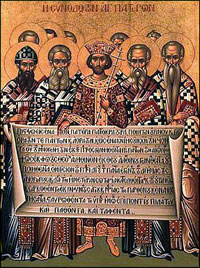
Typically, detractors opposed to the Trinity will immediately use the name of Constantine in an attempt to show how the Council of Nicea was used to promote a pagan concept of God. When someone does this, ask her how well she has studied the process of how the decision was made. Rarely have I found anyone able to explain the major players of the council (Alexander and Athanasius versus Arius), let alone the century the council took place (4th)!
The truth is that less than two dozen bishops (out of some 300) attending the council were ever in favor of Arianism, and by the time the council concluded, only two did not favor the Orthodox position. Truly Constantine’s goal was for reconciliation and had nothing to do with the decision made in Nicea, which was overwhelmingly confirmed in a fuller form at the Council of Constantinople in A.D. 381. As Steve Brandt points out,
“Constantine did play an important role at the Council. Eusebius of Caesarea reports that he played a key part in calming, convincing, and bringing all to agreement on contested points. The account of Eusebius fairly glows in regard to the Emperor, and he is portrayed as a key figure. It is nowhere suggested, however, that he was permitted to vote with the bishops nor that he used any form of force to obtain an outcome.”
While the word “Trinity” is never used in the Bible, neither is the concept “Heavenly Mother” nor “Paradise Earth” used in the Bible, even though some might argue these are biblically true ideas. Yet the Trinity clearly solves problems and is a correct belief based on the teaching of the Bible. It shows that, while there is one God (Deut. 6:4; Mark 12:29), there are three separate Persons who are fully and completely God. (Quick. Who raised Jesus from the dead? Of course, God the Father did according to Acts 3:15. But Jesus also raised Himself from the dead, according to John 2:19 and the Spirit gets credit in Romans 8:11.)
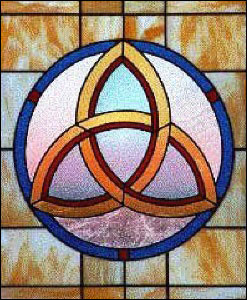
The Trinity is supported by the testimony of Jesus as well as His apostles and brothers. In his book What Have They Done with Jesus, New Testament scholar Ben Witherington III carefully considers the early witnesses of the historical Jesus Christ. In his conclusion on page 291, he writes,
“The historical probabilities surely lie with the suggestion that these were honest witnesses, struggling mightily to explain the significance of a person they had encountered and who, in the process had irrevocably changed their lives. One has to decide, then, whether the Jesus they remembered and tried to explain, grasping after terms and titles large enough to convey his importance, was the real Jesus or not. Bear in mind that it is not a matter of trusting much later Christian testimony—say, for the Council of Nicea conspiracies to concoct a Jesus-is-God theology. No, it is a matter of trusting the very earliest witnesses of the historical Jesus, some of those who knew him best.”
James R. Edwards, a biblical languages professor at Whitworth College in Spokane, WA, agrees, writing in Is Jesus the Only Savior that “we do not find an evolutionary trend to elevate Jesus in the creedal tradition of Christianity” (p. 69) In fact, he writes on pages 55-56,
“The idea that the early church fabricated a portrait of Jesus that eventually resulted in the Nicene formulation of ‘true God of true God’ from a historical Jesus who was simply a first-century Jew about whom little was known, and who was either uncertain or confused about his identity, is a highly improbable—and unadvised—leap of faith. It is not surprising that an imposing line of biblical scholars has opposed it for nearly two centuries.”
It would be refreshing for critics of the Trinity to refrain from attacking the Council of Nicea to disprove the Trinity. If you don’t agree with the Trinity, use scripture for your source. This is a much better place to begin.
Comments (102)
I just wrote a lengthy paper on this for Seminary with an emphasis on why Mormons and Jehovah’s Wintesses deny the Council without any demonstrated proof, validation or sources. Mormonism and Jehovah’s Witnesses must deny the Council of Nicaea in the interest of attempting to validate their own doctrines. If they accept that the council was a legitimate council with a purpose to use scripture in defense against a heresy that Arius was introducing, to them would be self defeating. This has prompted them to latch on to every conspiracy, falsehood and misinterpretation of the Council of Nicaea and Constantine’s involvement. It is even more interesting when I read statements by LDS leaders that make outlandish claims against the council without sources. I find it ironic how the heresy that Arius attempted to introduce, is one of same heretical doctrines that Mormons attempt to perpetuate in their doctrine to this day.
Additionally, they cannot use scripture as you know Eric since scripture validates the Trinity repeatedly. Even their own writings work against them. I was talking with a Mormon on the street recently and we were going through this exact issue and I opened up the Book of Mormon that I carry to Alma 11:44 (you can also look at Ehter 3:14). His response was “That is a tough verse, even Mormon Scholars do not know what to think of it.” I really think they just do not want to accept that Jesus Christ is Lord!
I did a topic on the trinity that is in depth with Scripture to support it, but way to much scripture to post here, for all who want to view it you can go here: http://mormonismreviewed.blogspot.com/2006/01/trinity-in-bible.html
Rick b
This is a subject that I am currently struggling with. I have recently resigned from the Mormon church and have gone back to my Protestant roots, but the issue of the nature of God remains a question for me. Here’s why:
“In your own Law it is written that the testimony of two men is valid. I am one who testifies for myself; my other witness is the Father, who sent me.” John 8:17,18 NIV
If we read this same verse, but substitute the pronouns to support the doctrine of the Trinity, it would say: “In your law it is written that the testimony of two men is valid. I am one who testifies for myself; my other witness is myself [as the Father], who sent me.
That’s still only one witness, not two. A singular being in two or three forms is still one being, one witness. If God is truly one being, then He can never be more than one witness. And we learn from scriptures that God, Jesus Christ, and the Holy Spirit are counted as separate witnesses (like in verse above). But under the Trinity how can that be possible?
Try this test. If you really believe in the Trinity (and I want to!!) substitute “I” or “me” for each person of the Trinity in a verse and see if it makes sense. John 11:41 actual verse: ” . . . Father, I thank you that you have heard me. I knew that you always hear me, but I said this for the benefit of the people standing here, that they may believe that you sent me.” Same verse with substitution: ” . . . Me, I thank me that I have heard me. I knew that I always hear me, but I said it for the benefit of the people standing here, that they may believe that I sent me.”
That’s why I have trouble with the Trinity. If we substitute the pronouns to support the Trinitarian philosophy of God just being one entity, then the verses make no sense. The scriptures would teach that God talks to himself, prays to himself, glorifies himself, even sacrifices himself.
Please help me understand.
Kelly,
I liked your last line “….even sacrifices Himself.” (which of course He did) I was reading through Ephesians one time and decided to highlight in blue the pronouns that referred to the Father and in Red the pronouns that referred to the Son. It was a very interesting exercise. It had me scratching my head in a few places, but it helped point out to me the unique work of each. How about when Jesus was baptised and we see Him in the water, the Spirit descending in the form of a dove and the Father proclaiming “This is My beloved Son.” Do I get it? No! But I won’t diminish Jesus by saying He is a created being and not fully God.
Kelly,
This isn’t the Trinity, this is modalism (something that the BofM and JST ironically seem to teach). The Trinity rejects the notion that God is one person who manifests himself in three forms, and instead embraces the full reality that the Father, Son, and Spirit are three interrelating persons who have always been in full, interpersonal fellowship. The Son doesn’t pray to himself, he prays to the Father. The Father doesn’t send himself or sacrifice himself, rather he sends the Son to be “crushed” (Isaiah 53:5,10).
I think perhaps one problem is that you’re confused over the distinction between “being” and “person”. The doctrine of the Trinity rejects the assumption that a being is always only one person, and that a person is always a being unto himself alone. The three persons inseparably exist together as one God, one being. The personal pronouns you are looking at refer to one person, not all three persons of the one being of God.
In John 1:1, the writer speaks of the “Word” (Jesus Christ) as, in the beginning, “with God” and “was God”. A big question about Jesus is: how can he be God and be with God at the same time? The early Christians were driven inevitably to the Trinity because they recognized there was only one God, and that the Father was God and the Son was God and the Spirit was God, and that the Father was not the Son and the Son was not the Spirit and the Spirit was not the Father, etc.
We ought to worship the Father and Jesus like the angels do in Revelation 4 and 5, but this is polytheism if the Father, Son, and Spirit are three gods and three beings.
I heartily recommend the audio available over at the Theopedia article on the Trinity!
Best wishes,
Aaron
I believe Aaron explained it well. As I study Greek you see a reinforced understanding of the Trinity in Scripture. Especially in passages like John 1:1. The Greek in the uses of the cases, the lack of a definite article and the emphasis state very explicitly that God was with the Word and God was the Word. In fact the way it is written in the Greek there is no question about what the author was trying to say. John 1:1c says in the Greek “and God was the Word” The word order alnoe tells us that Jesus has all the attributes of the father, and the lack of the article shows that even still he is not the father. Martin Luther said, the lack of an article is against Sabellianism; the word order is against Arianism (Mounce, pg 28 Basics of Biblical Greek).
Thank you Aaron and Falcon, I appreciate you both addressing my question. I realize that I have a lot to learn (or maybe re-learn), but I guess something in me wishes that God was a little easier to understand.
If we are created by Him, and He is in us, it seems that His nature should be familiar to us, and that we should be able to describe His nature in a few words. I think that’s why the Mormon Godhead of three separate beings appealed to me. Their version of the Godhead could be fully described in one sentence. That being their only advantage, I do see the problems (like polytheism)in the Mormon Godhead as well.
I will print out your answers and read them more closely. I also have a book by R.C. Sproul called “Truths We Confess.” It is a three part series and volume one is called “The Triune God.” I believe this is a Presbyterian look at the nature of God, and since I am attending a Presbyterian church at the moment, I thought it made sense to look into their take on the subject. I’ll also look at your recommendations.
Thanks again!
Kelly
Andy,
Thanks to you as well. I enjoy reading Martin Luther, so he is another good source to look into. My dearest friend is a very well versed Lutheran, and she, along with forums like this, has helped make my transition out of Mormonism a lot less bumpy.
Andy and Kelley,
This is a little off topic, but our discussion here makes me wonder about the grip Mormonism has on people. You folks are working your way out, but I’m wondering about the spiritual, emotional, social and intellectual aspects of the trap. I see your search for truth in our discussion here about the theology and doctrine of the Triune God. Do you have to deal with all four aspects that I mentioned here and is one easier than the other to deal with?
Dear Kelly,
I understand your difficulty with such areas as the Trinity, the finite trying to comprehend the infinite.
2 Peter 3:15-16 says -as also our beloved brother Paul, according to the wisdom given to him, has written to you, as also in all his epistles, speaking in them of these things, in which are some things hard to understand, which untaught and unstable people twist to their own destruction, as they do also the rest of the Scriptures.
Whenever I have talked with MMs they always point me to Genesis 1:26,27 And God said, Let us make man in our image, after our likeness…So God created man in his own image, in the image of God created he him; male and female created he them.
You know the LDS reasoning using the word ‘image’ so I won’t explain it. But the last part it says that God created male and female in His image (Hebrew: likeness, similitude). God is not male and female.
To make this quick, and unfortunately when something is said quick it can lead to unsatisfactory answers. This subject is a lot more complex than just 2000 words, but in essence man is a representation of God. Man is composed of three: soul, body, and spirit. The Soul is not the spirit, the spirit is not the body, and the body is not the soul but the three make up the human being. God is three in one: Father, Son, and Holy Spirit. The Father is not the Son, the Son is not the Holy Ghost, and the Holy Ghost is not the Father, but yet the three make up one God. God however, is Eternal, Omniscient, Omnipotent, Omnipresent, Self-Existent, and Infinite. Whereas man is NOT any of those.
Whenever you get into the doctrine of the Trinity you inevitably enter into Philosophy: Metaphysics and Ontology. There is a book that I’m reading called “Philosophical Foundations for a Christian Worldview” by Dr J.P. Moreland and Dr William Lane Craig. It’s very heavy and thick but they have chapters on the Trinity and the Incarnation which I recommend.
P.S. Dr William Lane Craig has a website that might interest you (www.reasonablefaith.org) he also has two podcasts. If you’ve heard about the popular book called “The Case For Christ” by Lee Strobel, Lee interviews Dr W.L. Craig in one of the chapters. My wife recommends a smaller book “Hard Questions, Real Answers…” by the same author. This book deals with topics such as doubt, unanswered prayer, failure, suffering and evil, abortion, Homosexuality, and Christ – the only way.
Falcon,
Mormonism has a tremendous grip on the strong believer. Sometimes I still catch myself in the Mormon mindset and have to stop and adjust my thinking (especially when it comes to the many Mormon laws).
I have one objective in the questions I’ve asked, and that is to understand who it is I am worshipping. What would be God’s objective in making His nature so hard for us to understand? Does He want us to invest ourselves in pursuit of that knowledge?
M2,
Your example of man being soul, body, spirit was very helpful, and I like the scripture in 2Peter you cited. I used a similar scripture in my resignation letter, Gal 1:6-8 “I am astonished that you are so quickly deserting the one who called you by the grace of Christ and are turning to a different gospel – which is really no gospel at all. Evidently some people are throwing you into confusion and are trying to pervert the gospel of Christ.”
If I can get this matter settled in my own life, it will go a long way toward helping my Mormon husband to leave the LDS church. Right now the idea of the Trinity is absurd to him (but polytheism is not, I guess). If I can come to peace with it, I can help him to do the same.
Dear Kelly,
Here are some scriptures for you:
1 Timothy 4:15-16 Meditate upon these things; give thyself wholly to them; that thy profiting may appear to all. Take heed unto thyself, and unto the doctrine; continue in them: for in doing this thou shalt both save thyself, and them that hear thee.
2 Timothy 2:15 Study to shew thyself approved unto God, a workman that needeth not to be ashamed, rightly dividing the word of truth.
Unlike traditional Mormonism, Christianity teaches that our purpose in life is to know God.
Matthew 7:21-23 Not every one that saith unto me, Lord, Lord, shall enter into the kingdom of heaven; but he that doeth the will of my Father which is in heaven. Many will say to me in that day, Lord, Lord, have we not prophesied in thy name? and in thy name have cast out devils? and in thy name done many wonderful works? And then will I profess unto them, [I never knew you]: depart from me, ye that work iniquity. (brackets added for emphasis)
How do we know God?
Here are some thoughts:
We have to love Him in return: Matthew 22:37 Jesus said unto him, Thou shalt love the Lord thy God with all thy heart, and with all thy soul, and with all thy mind.
If you love God you will apply your heart (emotions), your soul (essence), and your mind (thoughts, understanding, learning, etc)
As you spend time with God in learning, praying, meditating upon His Word, renewing your mind (Rom 12:2) etc. you are loving Him…Our relationship to God is like when two people are dating, they send letters to each other, talk to each other, hang out together, and think about each other all the time. This is what it’s like to be enamored with God. And out of this process we become like Him. Just as two best friends resemble each other out of all of the time that they have spent with each other, this is what our relationship to God looks like.
What would be God’s objective in making His nature so hard for us to understand? Does He want us to invest ourselves in pursuit of that knowledge?
The second part should be answered above. The answer to the first one is in short. God didn’t make himself hard to understand to us (He isn’t hiding anything nor did He make Himself). The reason that we have a hard time understanding him comes from sin (corrupt minds). Us trying to understand (perfectly) the mind and essence of God is like an astrologer standing on a chair trying to touch a star. This does not mean that we can’t have some understanding, because God has revealed to us who He is. Plus, we would have to be God in order to fully understand Him. Just as why most men don’t understand women and why women don’t fully understand men. Even though we are both humans we are nothing alike. Just as we were made in the similitude of God that doesn’t mean that we can fully understand Him. God commanded us to get to know Him as He told Husbands to understand their wives (1 Peter 3:7). The more I learn about my wife the more I appreciate her, even though I know that I will never completely understand her. The same is with God, the more I learn about Him and get to know Him the more I appreciate Him, even though I will never completely understand Him.
M2,
Thanks for the scriptures and the counsel. The 15 years I spent as a Mormon have robbed me of many things. A healthy, proper relationship with God is just one of them.
Many get upset that the Trinity is so hard to understand. But even Philosophers have yet to understand such things as the Relationship of the Mind and Body.
i don’t have a problem, theologically that people believe in the trinity, it is better than not believing in God at all.
but…they’ll need to clarify this scripture for me
Acts 7:
55 But he, being full of the Holy Ghost, looked up stedfastly into heaven, and saw the glory of God, and Jesus standing on the right hand of God,
56 And said, Behold, I see the heavens opened, and the Son of man standing on the right hand of God.
so Stephen feels the Holy Spirit, Sees God the Father, and Jesus standing on His right side…then he is stoned for this belief
Dear Amanda,
I will try to answer your question. These verses alone would seem to be a problem. But I want to first state that as “Evangelicals” we believe that God is Spirit (John 4:24) and is omnipresent (Deut 4:39; 1 Kings 8:7; 2 Chronicles 2:5-6). God would have to be omnipresent if He’s omniscient. You can’t know all unless you see all. You cannot see all unless you are everywhere present. So thus the reference from Acts 7 becomes a reference to Jesus’ place of authority and honor. “Right hand” (even for us today) is a symbol of power (take a look at Matt 26:24). Because if God is everywhere (Psalms 139:7-8) then Jesus’ relation here in Acts is not spacial but is positional.
I hope this answer helps. I just want to say one last thing, I know you have gotten upset with some of the people on this blog Amanda. I want to apologize for us men. Sometimes we get way to excited about the topic and we forget that we’re talking to actual people who have feelings.
sure, in terms of the scripture, that interpretation is at least logical.
let me explain some key similarities that actually separate us.
i believe that god the father, his son Jesus Christ, and the holy spirit are “one”. one is interpreted to mean one in purpose. We pray in Jesus’ name TO the Father. he is our intercessor, he pleads for us to the Father, and is the supreme judge in Israel because he atoned for our sins, making himself our father. in a way, they are one, because His purpose is God’s purpose. Their messages are one eternal round. so it can be interpreted both ways. i happen to feel more intimate with the doctrine that Jesus was our heavenly brother who descended to save us all, and he did it because he desired his Fathers will to be done. it makes the garden of Gethsemane a very real plead to His actual Father, putting trust in Him, and desiring to do as His father would have him do. it is a stunning parallel with the desires the savior would have from us.
i love the scriptures, there is so much symbolism that so lovingly points us back to the Father, and teaches us the mysteries of the kingdom of heaven.
Falcon said:
This is a little off topic, but our discussion here makes me wonder about the grip Mormonism has on people.
Imagine! A religious paradigm, witnessed by the Holy Spirit and used as a guide to interpret and understand God’s word and the world we live in, actually having a grip on people!? What are you saying? Are you saying that creedal Christianity has no such “grip” and that the entire exercise of this site is truly a “search” for more truth? Of course not! This is an exercise in persuading others that they are WRONG in their beliefs, and no amount of talk, interpretation, explanation, dialogue or scriptural explanation seems to ever allow one side to say to the other “AHA! I see your point — I disagree — but I see how you got there”. Maybe Falcon, you should examine the strength of your own paradigm, your motivation for commenting here and your own desire to persuade others that you are right and they are wrong — then you will understand the “grip” Mormonism has on people. You won’t have to agree with it, but you can understand it.
I am also increasingly frustrated with the trap that is set in so many times in this forum — which can be detected in this very posting, and which has limited the time I now spend here. Often questions are asked of Mormons and answers are demanded. If a lengthy answer is given in order to try to give background, texture, context and understanding, we are accused of parsing words, of nuancing and of being less than forthright in the answer and a demand is made for a simple, definitive statement. If, on the other hand, a simple, straightforward declaration is made (at the expense of a fuller, more complete answer), we are accused of “not telling the whole story”. Well, this is your site and you can do what you please, I just hope that those who are reading as true questioners will understand that your intention is not a dialogue or a search for true understanding.
[...] yesterday, I empathized with Eric’s provocative post on the Trinity. And Aaron S.’s article recently downright blessed my [...]
Dear Amanda,
I understand that there are essential and peripheral differences between Mormonism and Orthodox Christianity. This is the reason that there is such a large dichotomy between the two and the reason that Mormonism is excluded from being considered a denomination of Christendom. When the world looks on at Christendom and at Mormonism they see purely the moral aspects and the similarity in terminology and not the doctrine. Many say, “look at their fruit!” and this is interpreted as meaning ‘good works’. But if being called Christian is merely based upon our works then we would also have to call the Jehovah’s Witnesses Christian, Christian Scientists Christian, RLDS Christian, and FLDS Christian. Obviously there is something that separates us and does not allow it to be reconciled. This is doctrine…which is the most important. In one of you’re other posts you said,
“…then whose word is it? satans? well, i find it hard to believe that satan would author a book that would lead millions to the savior.” I would like to address this here because I find it more applicable. My question is, what savior do you have? In 2 Cor 11:3-4 it says that there are other Jesus-es, other gospels, and other spirits. You have different doctrine, so this means that you have a different gospel, different spirit, and a different Jesus.
M2,
The fact that we understand Jesus differently than creedal Christianity doesn’t make you right or us wrong. It makes us different. I am a Christian because I am accepted by Christ. Your opinion of me is irrelevant.
Dear Neal,
I’m not exactly sure what you were trying to say. First off, I don’t recall ever giving an opinion about you (personally).
You said,
“The fact that we understand Jesus differently than creedal Christianity doesn’t make you right or us wrong. It makes us different.”
Yes, I firmly agree that we differ on the personage of Jesus the Christ. For example
LDS: Jesus is the brother of Lucifer
E.C.: Jesus created Lucifer
LDS: Jesus is a god amongst many gods
E.C.: Jesus is GOD
LDS: Jesus was born by a literal conception of Elohim and Mary
E.C.: Jesus was born of the Holy Spirit through the virgin Mary
LDS: Jesus was married to at least three wives while on earth
E.C.: Jesus never married
Those are just four points of major difference. So either you’re right and I’m wrong or I’m right and you’re wrong. Just as Islam teaches that Jesus was a prophet of Al’ah and was never crucified, Christian Scientists claim that Jesus is a divine idea, New Age teaches that Jesus Christ is a position of enlightenment. These cannot all be the same Jesus, these are all different Jesus-es. The LDS church and Evangelical Christianity do not have the same Jesus.
Dear Neal,
You said,
I am a Christian because I am accepted by Christ.
Again I ask, “Which Christ?” (reference 2 Cor 11:3-4). Our foundation is the person of Christ (1 Cor 3:11). And obviously what we believe about Christ is important(John 8:24) to the point of being forgiven our sins. So, here’s a personal question to ask yourself, which Christ do you have, the right one or the wrong one and why or why not?
Let me be more clear — I wasn’t speaking of me personally but me collectively as a member of the LDS church. Whether you or any of those you deem Christians deem me or my fellow members of the LDS church as Christians is irrelevant. I have accepted Christ and have had a witness of the Holy Spirit that He has accepted me. I seek His forgiveness and His guidance. I worship God, do my best to serve His children, and try to be more like Him every day in my thoughts and my actions. I’m uncertain why you felt it necessary to outline doctrinal differences to prove the point I have already given you — there are doctrinal differences in our understanding.
Dear Neal,
You said,
“Your opinion of [me] is irrelevant.” (bracket added for emphasis)
So I naturally assumed that you were speaking personally.
You said,
“I have accepted Christ and have had a witness of the Holy Spirit that He has accepted me… I worship God…I’m uncertain why you felt it necessary to outline doctrinal differences to prove the point I have already given you — there are doctrinal differences in our understanding.
Again I ask, “Which Christ, which Spirit, which God?” I did not put those doctrinal differences there to prove your point. My point was and is that we have such vastly different beliefs in “Jesus Christ” that they have to be different Jesus-es, to the point that somebody has to be right and somebody has to be wrong (law of non-contradiction and law of identity). Just because we (individually or corporately) claim to believe in Jesus Christ, Holy Spirit, and the Gospel doesn’t make us Christian. What makes a person a Christian (and/or saved) is ‘what do they believe about these three?’
To put it another way, a lot of countries that are neither democratic nor republican in political structure call themselves “democratic republics.” The sincerity with which they use the term should not be confused with the fact of what they are.
By the same token, I think Mormons err (though sincerely) by confusing “christian” (an adjective), with “Christian” (a noun), meaning those who adhere to Nicene Christianity (i.e., the vast majority). Mormons would be better described as “Anti-Nicene Christians.”
On this subject specifically, I think it would prove very useful if Mormons frankly and proudly declared themselves Arians, which is precisely what Mormon doctrines dictates. It would avoid a lot of pointless debate.
Neal,
First of all I stick to the Apostle Paul’s admonition to Timiothy to defend the faith. When Paul confronted error he did so straight-on (see his reaction to Peter’s refusal to mingle with the gentile belivers). Secondly, I’ve been reading way too much from exMormons regarding the difficulty they have just simply getting their names off the rolls of the Mormon Church not to think that there is incredible pressure on members not to leave the program.
Or ante-Nicene, if you please.
“The fact that we understand Jesus differently than creedal Christianity doesn’t make you right or us wrong. It makes us different.” I’m sorry, but this is absurd on its face.
The Mormon Church is built upon a foundation of non-negotiable assertions: all other Christian sects are wrong and lost any claim to valid priesthood authority millennia ago. The Mormon convert must reject his previous religious convictions and his previous congregation and his previous sacraments (including baptism and marriage). No dual citizenship is allowed.
And all the more power to such beliefs. It’s a free country. But Mormonism is NOT ecumenical. It does not teach a get-along, go-along, heart-in-the-right-place theology. My, how I miss the old days when Mormons proudly proclaimed themselves a “peculiar people.” When they made bold claims and stuck to them.
I admit there is much I do not know about the history of Christianity, but I still think that a meeting of 300 men to discuss/formalise what they want the rest of society to believe about God’s character is still people deciding their beliefs. I can understand from the various scriptures presented when someone discusses this with me why people can decide to believe in the Trinity, but from my own beliefs I do believe that their interpretation of those scriptures is wrong.
For instance – the scripture given above, John 1:1 – describes at best a Duality, not Trinity. It in no way shape or form includes the Holy Ghost. Then according to a website I have found (it is a Muslim one) the verse can be translated two different ways, and has been in other versions of the Bible (New World Translation, The New Testament and American Translation, The Holy Bible by Dr James Moffatt, gives a few other references). It says that besides reading that “the Word was God” it can also be translated as “the Word was divine”. Now if this scripture helps define a fundamental Christian doctrine, shouldn’t it be translated the same through the Christian society?
The site goes on to show that there are no scriptures in the Bible that describe a Trinity, whether explicit or implicit. Yes, it states ‘one God’ but at best, most of the scriptures used can only define a Duality – that of God the Father and Jesus Christ.
For those who want a look the website is http://wings.buffalo.edu/sa/muslim/library/jesus-say/ch1.2.2.6.html.
M2, now you are arguing semantics.
the book of mormon that i read testifies of Jesus Christ of Nazareth who was crucified on the cross for the sins of the world. that pretty much narrows it down…so we believe in the same Christ- and the only reason people say otherwise is because it then gives credibility to the message of the book of mormon, and if that happens, then maybe the mormon church is the restored gospel on this earth. but i don’t expect anyone will come to that conclusion on this website…surprise surprise!
so we agree to disagree because it’s not going anywhere. we’ll find out and that great and last day…and i’m comfortable with that scenario.
I tend to look at things as we (LDS) believe in a different God than main-line Christianity because we interpret the Bible differently. However, we do believe in the God of the Bible according to our interpretation. As for Jesus – we believe in the same Jesus as a person/being and as our Saviour – we just do not believe in Him as part of a Trinity. So its the same Jesus but a “different” God.
But that’s the same with all Christianity. There are at least 4 differring versions of God and Christ in the NT believing community. Only ONE of them is correct but all come from the Bible. The 4 I am aware of are the Trinity, Modalistic Trinity, LDS Godhead and the JW version. So you need to determine which one you want to believe in and then ‘defend’ that position and try to convert others in order to save them – which is what we are doing here.
Lancaster,
Not so fast! I didn’t say that it was time to be ecumenical or set aside our serious doctrinal disputes. I am making one single point. My disagreement with your creed does not make me a non-Christian. I don’t accept your creed, but I accept Christ, as I understand Him, His mission and His atonement. THAT makes me a Christian. You have no right to define me otherwise. The LDS claims of modern revelation, restored authority, new scripture and doctrinal clarity are powerful, revolutionary and wonderful. I am not backing away from them. I am disputing your right to call into question my Christianity because we disagree.
And Falcon — c’mon man — you telling me there is no pressure on an evangelical who determines that they want to join the Mormon Church? Do you throw a party for them and wish them well? The very presence of this site argues otherwise. All of us who believe strongly fight hard to hold onto those we feel are making wrong choices. You do and I do. Don’t be disingenuous and say Mormons are the only ones.
Neal,
Personally, I don’t think it’s all that difficult for someone to leave an Ev. Church and get their names removed from the rolls. In Mormonland, someone who leaves pays a big price in both subtle and direct means. This is especially true if Mormonism is the prevailing religion of a geographical area. This opinion comes from anecdotal reports which are numerous.
I find the idea that the true Gospel was lost after the death of the original apostles quite convenient. As in the “every church is wrong, I am right, follow me” scenario. And then of course the prophet must come up with doctrinal ideas that are totally out of phase with normitive Christianity in an attempt to prove that standard Christianity is damaged goods. I really don’t think that the original apostles believed that there is a mother god and father god who procreate spirit children who will become human and some day if they get themselves righteous enough achieve the highest heaven and be gods themselves. It is however, just fantastic enough to lure people in. I think this belief system would qualify as another Gospel…..which isn’t really a Gospel at all. But I do know that it wasn’t the original Gospel. I can testify to that.
Falcon,
Interesting and valid OPINIONS all. You have the right to them. We are different. I’m not arguing that we’re not different. I’m pointing out that our differences don’t make me non-Christian. They make me non-You. That’s all.
Also, I don’t disagree that there are stories of people who have a difficult time leaving the LDS Church, particularly, as you say, in areas where there is a large concentration of LDS people. For every anecdote you can give me, I can find three other equally wrenching tales of people from all religions who decide to be baptized in the LDS Church. People are disowned, bullied, lied to, threatened, cajoled, ignored — all manner of unChristlike behavior — because of their decision. I’m not pretending it doesn’t happen in the LDS Church. I’m asking you to stop pretending it doesn’t happen in others.
Here is a really good help for anyone interested in looking at the BIBLE alone to see if the doctrine of the Trinity is true. There is no question in the Bible that the Trinity is validated. It is not creedal or made up by man (only the word) the concept is what is written about throughout the Bible.
http://www.wayofthemasterradio.com/pdf/DeityofChrist.pdf
Ralph, Neal, and other Mormons-
Before Mormons completely dismiss what occurred at Nicea, (like I used to do as a Mormon), they should look for a precedent in the Bible. That precedent is the Council at Jerusalem. The early church leaders, even your “prophet” Peter (though Peter is never called a prophet or even eluded to in that way in the NT) was there.
Acts 15 tells all about the Council at Jerusalem. That council was, perhaps, what the Nicean council was modeled after. And why not, the early church leaders needed a model, a forum, for discussing doctrine, and the Lord had provided one for them right there in Acts (the NT was pretty much compiled by 150AD, and there could have been oral traditions as well).
At the Jerusalem Council they were debating major doctrine about Gentiles coming into the Gospel, so it was no small matter (especially for the men). The council seemed to be productive, and the process was not rejected by God.
So what is the big hang up about, as Ralph put it, “a meeting of 300 men to discuss/formalise what they want the rest of society to believe . . .”?
I guess the meeting of 15 men in a little room in a temple to determine doctrine (and yes, they do debate, sometimes heatedly) is perfectly normal, but 300 men, that’s absurd! Apparently God doesn’t agree with you.
The Council at Jerusalem didn’t determine doctrine in the sense of creating doctrine, rather it confirmed what God had already revealed as doctrine through his word and through his work of the Holy Spirit.
The same goes for the Council of Nicaea. God had already revealed in his word that Jesus is eternal and not created (contra the word-twisting Arians).
I agree with you Aaron, and that is what I stated above. It was only at the end of my comment that I pointed out the hypocrisy of the LDS using the same format as the Jerusalem and Nicean Councils themselves when “the brethren” meet in the temple to determine doctrine.
It is the LDS that have to create the doctrine from nothing. They certainly can’t be *clarifying* questions about Masonic temple rites, or the logistics of eternal polygamy based on the Scriptures (well, unless you count the Journal of Discourses as scripture, but then that would open up another can of worms, wouldn’t it).
I don’t have a big problem with orthodox Mormon doctrine. I probably remain more theologically aligned with the Mormonism of my youth than I do with the full sweep of Evangelical beliefs. But what I find endlessly frustrating is the Mormon refusal to recognize their own strident lack of reciprocity vis-à-vis other religions, and their refusal to realize that debates are not won simply by robbing words of their meanings.
Mormons get upset when others don’t accede to their self-identification as “Christian,” yet turn around and declare that no Christian can be saved except according to Mormon ordinances. Correct me if I’m wrong, but Evangelicals don’t insist that salvation is conditional upon the specific congregation one belongs to. Mormons do.
To extend my previous analogy, a federal republic like the U.S. doesn’t insist that all democracies be federal republics to be legitimate. In fact, most democracies have parliamentary-style governments. But when it comes to salvation, it’s Mormonism or nothing. It’s Mormon baptism or nothing. It’s the Mormon Church or nothing. If the choices are that stark, then the underlying beliefs must be incompatible.
The Mormon definition of “Christian” cannot be the same as the rest, else those distinctions would be meaningless. That’s why I say that Mormons shouldn’t shrink from defining their concept of the Trinity as Arian, because that’s what it is. That’s why I’m not being all that facetious when I suggest that Mormons call themselves “ante-Nicene Christians.” Because that’s what they are.
As Lincoln purportedly queried, “Can you say a dog has five legs if you call the tail a leg? No. Calling a tail a leg doesn’t make it so.”
Neal,
I have a question for you, can I call myself a Mormon and not believe in the BOM, POGP, and the D&C? Can I call myself a Mormon if I do not believe in Joseph Smith or Gordon B. Hinkley? Can I call myself a Mormon and not be baptized in the Temple?
Dear Amanda,
I’m not quite sure why you said that I’m just arguing semantics.
You said,
the BOM that i read testifies of Jesus Christ of Nazareth who was crucified on the cross for the sins of the world…so we believe in the same Christ-…
For starters, the LDS church teaches that Christ paid for our sins also in Gethsemane. Also when I talk about a different Christ I am including all of Mormon Theology, not just the BOM. For example, the Bible and the BOM say that Jesus was conceived by the Holy Ghost (Alma 7:10) and that Mary was still a virgin at the birth of Jesus (hence the term Virgin Birth). I would agree with the BOM on this point, but where I would disagree is in the same verse of Alma it says that Jesus was born in Jerusalem. Jesus was born in Bethlehem, not Jerusalem. But this brings up a quick question, if Jesus was conceived by the Holy Ghost, why is Jesus called the Son of God? I think Brigham Young realized this problem, that’s why he said in JOD V.1, p51, Apr 9, 1852:
“…Jesus our elder brother, was begotten in the flesh by the same character that was in the garden of Eden, and who is our Father in Heaven. Now, let all who may hear these doctrines pause before they make light of them, or treat them with indifference, for they will prove their salvation or damnation. I have given you a few leading items upon this subject, but a great deal more remains to be told. Now, remember from this time forth, and for ever, that Jesus Christ was not begotten by the Holy Ghost.”
The LDS church teaches that Elohim had sexual relations with Marry… his spirit daughter. There are many reasons that Orthodox Christianity rejects Mormonism and its prophets. Just because the LDS church uses the name of Jesus Christ doesn’t make it true (Matt 24:4-5,11,24-25). The MMs encourage us to pray about the BOM and we will receive a feeling in our heart. But the Bible speaks out about trusting in our hearts and feelings: Jer 17:9; Prov 28:26; Mark 7:20-23.
If one wants to try to understand both the Trinity and Hypostatic Union in Christ, I would suggest obtaining a copy of “Theology and Sanity” by Frank J Sheed. Frank’s a Papist (as also I) but Catholic or Protestant his explanation of these doctrines are the best their are out there for those of us who are not degreed theologins.
By the way, as I recall Nicea (and Constaniople that followed) were councils of the (dare I say it) Catholic Church and the defenders of Orthodoxy against Arianism (and Neatorianism and Macronism and Gnostiocism etc., etc.) were Catholic Bishops. Something to think about.
Somebody(s) help me out here!
I’ve really been enjoying this discussion regarding the doctrine of the Trinity and the opposing views of Mormonism and normative Christianity. So here is my question: Do Mormons believe what they believe based on evidence or based on revelation? I’m assuming that the feeling Mormons get after praying for confirmation from God is part of the revelation process. For example, Joseph Smith was a prophet and the BOM was true, despite the DNA evidence, the archeological evidence, the linguistic evidence and documented nefarious activities on the part of the prophet. I prayed about it, I got the confirmed feeling, I interpreted that feeling at from the Holy Spirit, so JS is God’s prophet and the BOM is true.
So here’s the deal, if I can relate an actual event from my life to our readers here, that was intensely spiritual, emotional and had elements of the miraculous attached to it, does that make my doctrine correct. I do, by the way, have such an experience.
Kevin, be careful not to impose your 21st century definition of “Catholic” onto the 4th century. A lot has changed.
i have a question for all the REAL Christians…
do you believe, in light of the trinity doctrine, that the savior was having a conversation with himself in the garden of Gethsemane? that isn’t logical because he is conversing about the will of two different entities…or do you believe that he desired mortally to let the cup pass from Him but would submit to His spiritual will?
also, what is the nature of our souls after the resurrection? what will we be doing, our purpose after this life…will someone explain evangelical doctrine on this point…thank you in advance.
M2 (please forgive me if i do not address all of your points- i am feeling sick)
feelings in our hearts etc is just a generic way of saying “feeling the spirit” many people feel it differently, i have felt it differently..i have felt it calm my soul, i have felt it teach me in secular subjects such as science, and ethics….i have also felt it very strongly confirming to my MIND and HEART what is truth.
i believe in the jesus of the bible…and the jesus of the book of mormon..and up until now i understood them to be the same jesus…but now i am to understand that i believe in two different jesus’? are they related maybe? brothers? twins?
i don’t recall the savior saying that if i believe in Him and his distant relative who also died on the cross for our sins- then it doesn’t matter that i believe in the real jesus, because i also believe in another Jesus who is remarkably similar to Him. i’m sorry you guys, but that’s just weird. you can’t be serious. i think you should finally admit that we believe in Jesus..but if not, you risk sounding silly.
in all seriousness though, i find it preposterous that any of you claim to know what Jesus i believe in–maybe if you try reading your argument out loud to yourself you might realize how ridiculous it is…that’s what i do when i write an essay, i quickly find mistakes with my reasoning if i read it out loud. RICK B (there’s MY challenge
Lancaster,
you said,
“Evangelicals don’t insist that salvation is conditional upon the specific congregation one belongs to. Mormons do.”
you just can’t be mormon though then you for sure are going to hell…and mormons do not believe you must attend a mormon congregation in order to receive celestial glory..why do you think we do baptisms for the dead? when you see it through “mormon” eyes, as you claim to understand, when you really believe that Jesus Christ restored his church, you don’t thinking about his gospel as mormon doctrine (after all that name was not a name He gave the church, it was a name others gave it)..therefore it becomes inclusive because everyone at some point before the final resurrection will have the opportunity to accept Christs ACTUAL and real saving doctrine..whether you were mormon or evangelical.it’s not a contest -it’s a challenge to the individual and the condition of their heart and faith–no matter WHO they were in this life. and only God knows that.
that’s the thing that infuriates non-christians, and atheists about evangelicals – they’re always taking over God’s job like he’s on vacation or something..and all of you are trying to make up for His absence. aren’t you all comfortable in leaving your judgments behind and having confidence in God figuring out all this judgment stuff? and please spare me the judge righteous judgment scriptures, i’m aware of them and don’t find them applicable in this scenario..because he also says, judge NOT…so you can’t apply both interchangeably depending on the convenience it offers to your argument. judge righteous means that if you don’t believe in mormon doctrine, then you don’t join the church, but it doesn’t therefore give you free reign to judge an individuals worthiness or belief in Christ.
Amanda,
Be careful with that Jesus has a twin stuff. That could end up being Mormon doctrine. Seems to fit with all the other stuff.
Falcon,
i am not sure if you found your comment to be compelling? you might need to spell it out for me i guess.
i was pointing out the completely silly argument that mormons believe in the WRONG jesus. well, i guess i believe in two jesus’ because i also believe in the Jesus of the bible as well. my twin comment was only to illustrate further how ridiculously illogical this idea is.
Amanda,
The Jesus of the Bible is not the Jesus that is discribed by Mormon doctrine. This has been pointed out in detail on this blog with specific points contrasting the two discriptions. This is not just a matter of semantics. The definitions are important. Who Jesus is and what He did are at the foundation of Christian doctrine. The JWs say that Jesus is a created being, the Archangel Michael, if my understanding is correct. That’s a different Jesus. Counterfit money looks real and often passes as such, but that doesn’t make it real money. I sense that you have a heart for God and a longing for a deeper understanding and closer walk with the Lord Jesus Christ. The conceptualization and understanding of who Jesus is does make a difference in how a person walks and how a person worships and how a person prays.
i see and ;understand the differences as you laid them out…but that does NOT mean they are different Jesus’…that means each faith understands HIM differently. When you were a child, i’m sure your understanding of Him was different than it is today. there is certain TRUTH to the nature of Jesus and his purpose here in life…and all of us who believe in a Jesus are all on a path to understanding Him better, EVEN YOU. (besides, your example of JW’s does not apply when you are trying to argue mormon doctrine in Jesus…you didn’t actually list the major differences between evangelical and mormon)
your understanding of mormon doctrine is limited–just read the book of mormon, here are some scriptures (and you can then cross-reference biblical scripture that is fundamentally different than these scriptures in the book of mormon–if you can find them
)
Alma 37:9,13
9 Yea, I say unto you, were it not for these things that these records do contain, which are on these plates, Ammon and his brethren could not have convinced so many thousands of the Lamanites of the incorrect tradition of their fathers; yea, these records and their words brought them unto repentance; that is, they brought them to the knowledge of the Lord their God, and to rejoice in Jesus Christ their Redeemer.
• • •
33 Preach unto them repentance, and faith on the Lord Jesus Christ; teach them to humble themselves and to be meek and lowly in heart; teach them to withstand every temptation of the devil, with their faith on the Lord Jesus Christ.
1 corinthians 11: 1-3
Be ye followers of me, even as I also am of Christ.
2 Now I praise you, brethren, that ye remember me in all things, and keep the ordinances, as I delivered them to you.
3 But I would have you know, that the head of every man is Christ; and the ahead of the woman is the man; AND THE HEAD OF CHRIST, IS GOD.”
(caps for emphasis)
trinity?
logic suggests in this scripture: man, woman, Christ, God: SEPARATE entities.
Amanda,
How did Jesus come to be?
Here are some more scriptures in the book of Mormon that outline our belief in the Savior, Jesus Christ of Nazareth.
3 Nephi 5: 13, 20, 26
13 Behold, I am a disciple of Jesus Christ, the Son of God. I have been called of him to declare his word among his people, that they might have everlasting life.
• • •
20 I am Mormon, and a pure descendant of Lehi. I have reason to bless my God and my Savior Jesus Christ, that he brought our fathers out of the land of Jerusalem, (and no one knew it save it were himself and those whom he brought out of that land) and that he hath given me and my people so much knowledge unto the salvation of our souls.
• • •
26 And then shall they know their Redeemer, who is Jesus Christ, the Son of God; and then shall they be gathered in from the four quarters of the earth unto their own lands, from whence they have been dispersed; yea, as the Lord liveth so shall it be. Amen.
CROSS REFERENCE WITH THE BIBLE:
(This is relevant to my controversial comment about the bible and BOM complimenting each other—-RICK B!!!)
John 10:16
“And other sheep I have, which are not of this fold: them also I must bring, and they shall hear my voice; and there shall be one fold, and one shepherd.”
This means that there were other folds of sheep, followers of Christ, and they ALL are considered ONE fold– meaning the Jesus Christ in the Book of Mormon is the SAME as the Jesus in the bible, there is only ONE Jesus.
why are you deleting my comments? many users post back to back to continue their points…rick B does it all the time
sorry, my bad, i thought someone had deleted one of my comments, my apologies…
Falcon, How did Jesus Come into the world? via the virgin Mary.
you should know that
Consider what Joseph Smith translated (or WROTE according to evangelicals) i suppose even if Joseph Smith wrote this, it was some kind of fluke prophecy?
2 Ne. 29: 3-4, 6, 10
3 And because my words shall hiss forth—many of the Gentiles shall say: A Bible! A Bible! We have got a Bible, and there cannot be any more Bible.
4 But thus saith the Lord God: O fools, they shall have a Bible; and it shall proceed forth from the Jews, mine ancient covenant people. And what thank they the Jews for the Bible which they receive from them? Yea, what do the Gentiles mean? Do they remember the travails, and the labors, and the pains of the Jews, and their diligence unto me, in bringing forth salvation unto the Gentiles?
• • •
6 Thou fool, that shall say: A Bible, we have got a Bible, and we need no more Bible. Have ye obtained a Bible save it were by the Jews?
• • •
10 Wherefore, because that ye have a Bible ye need not suppose that it contains all my words; neither need ye suppose that I have not caused more to be written.
Amanda, you’re confusing me. You quote John 10 to show that, somehow, the Book of Mormon is validated. Then you go on to quote the Book of Mormon to show that the Bible cannot be trusted by itself. So, questions:
1) Does the Book of Mormon teach in one God? Three? Multiple? Do you have references to support this idea?
2) Jesus came from Virgin Mary, you say. Where do you get this idea? And how did the pregnancy take place?
3) You said, “logic suggests in this scripture: man, woman, Christ, God: SEPARATE entities.” It appears you think that the teaching of the Trinity does not allow for three separate Persons. Is this true? Could you give me a definition of what you think Christians teach about the Trinity?
Amanda,
I wanted you to back up a little further when I asked how Jesus came to be i.e. prehuman birth.
This is what I’ve learned thus far on this topic from the postings. The Mormon view of the trinity is basically repackaged Arianism, a heresy from early Church history. The Mormon view of the trinity was part of a “restored gospel”. But what Mormonism was restored to was heresy. That was what the defense of the Gospel is/was all about. There is the Gospel and heresy. The Arian heresy got the boot early in Church history along with several other aberrant heretical doctrines. Mormonism and JWism are merely continuing the fine tradition of early heretics. You can put a Chicago Bear fan in a Green Bay Packer sweatshirt and you still have a Bear fan. You can package Arianism in modern Christian speak (i.e. born again etc.) and you still have heresy.
eric, i think you misunderstood the bulk of my argument…and perhaps that is my fault. i found your comment however, because of this, confusing.
falcon, your argument is weak. (i’m not much of a professional football fan) the whole football analogy was lost in translation. much like your interpretation of the bible.
so you consider the teachings in the book of mormon, heresy? so when the book of mormon testifies of Christ, you call it heresy? when the BOM tells us to repent of our sins and put our faith in God, you call that heresy? When the BOM testifies of Christ’s atonement and his subsequent visiting of His other sheep, you call it heresy? what makes a religious persuasion heretic is their parting from Jesus and His actual purpose and atonement… and His teachings…ie the jews,islam (who consider jesus to only be a prophet), buddhists who believe in multiple gods and do not believe in a Savior, atheists who reject God altogether…so give me ONE example in the BoM that teaches heresy…heck, give me 5 examples, 10!
you know, the pharisees considered what Jesus Christ said about Him being the King of Israel, heresy. but He and the faithful knew otherwise. to the extent that they reject Gods word, WHEREVER it is the evangelicals are modern day pharisees. the pharisees considered the old testament to be scripture, but had difficulty accepting Christ. why? because he was just a carpenters son. (Joseph Smith couldn’t have restored the gospel through Jesus Christ because he was only 13–he didn’t see a vision.)
Evangelicals think that God only revealed himself to the Jews, and not to His other sheep…like as if God is limited in revealing
His word.
i also referenced scripture in the bible that prophesied of the evangelical rejection of Gods word, in the book of Mormon. you didn’t respond to that…nor did you respond to my other scriptural references. i’d appreciate an honest response to them this time, and not the usual MORMONS ARE HERETIC
Perhaps it was your fault as to the confusion. Regardless, you haven’t answered any of my three questions. I’m not sure what has confused you about them, but until I understand the answers to these, I have no ability to go beyond the typical “Mormons are heretic(al).”
Eric, let me make an attempt to clarify
1. do mormons believe in one god? two? three? and references…
the restored gospel teaches that we have a heavenly father, his son, jesus Christ, and in the Holy Ghost. (reference article of faith #1)
http://scriptures.lds.org/en/a_of_f/1
reference? Acts 7:55, HebreWs 12:2,
Moroni 9:26,
“And may the grace of God the Father, whose throne is high in the heavens, and our Lord Jesus Christ, who sitteth on the right hand of his power, until all things shall become subject unto him, be, and abide with you forever. Amen.”
so no one is saying that this can’t also be interpreted to mean god, jesus and the holy ghost being the same entity, however it certainly does more for the interpretation that God, His Son, Jesus Christ, and the Holy Ghost are separate entities, with ONE purpose:
Romans 15: 6 is an example of how the word “one” doesn’t mean literally being God Himself.
2. what do you mean where did i get the idea that the Savior came from the Virgin mary, that’s borderline insulting! now how did that pregnancy take place? please, that’s like asking a child to explain mathematically how man landed on the moon. it’s impossible. and don’t refer me to quotations that you will take out of context of a mormon apostle discussing how god had sex with mary, because it’s not what we believe and its not at all what they have said.
3. i have answered this point you made, above, except for what i think evangelicals believe of the trinity…
my father in law is a former baptist preacher, and we have had several discussions concerning this matter…they believe God descended to human form in order to perform the atonement. and the holy ghost, His spirit. and that is the ONLY explanation i have received. i am interested in further explanation.
i used john 10 to explain why it isn’t far-fetched or heretical to believe that the book of mormon is God’s word as revealed to OTHER sheep…not whether you agree or not. i’m sure you interpret that to mean something else, but i wasn’t trying to persuade you to interpret it a certain way, i used that scripture to explain doctrinally where mormons stand on this scripture.
so the book of mormon could be considered validated by this scritpure in the bible when interpreted that way.
Amanda,
1. So, do you believe three gods exist (Father, Son, HG) or is there just one, in your opinion?
2. As far as origin of Jesus, you say you are insulted. But the question was not meant to be so. I merely ask because the historic teaching of the LDS Church is that Jesus came from a physical relationship between Elohim and Mary. A Family Home Evening Journal from 1972 clearly shows this to be true (along with a number of other resources). Maybe you don’t believe your leadership, but they have certainly taught it. And no, I’m not just using some apostle out of context. The person who should be insulted is the Christian who holds quite dearly to this sacred teaching, as the LDS version is very blasphemous.
3. I’m unclear as to what your father-in-law taught. It seems you think that Christians hold in a teaching of the Trinity that is very heretical, called Sabellianism or Modalism. Yet the Trinity teaches that there is one God who is not just one in purpose but who is fully revealed in three Persons. The Father, Son, and Spirit are all fully God and yet not each other. The examples you’ve given throughout show that you really don’t understand what we teach or believe. Make a straw man, it’s easy to burn. But I think your straw man is nothing close to the version we believe. The Trinity actually makes much sense, especially when we look at the teaching of the Bible. We can go on and on in a blog and not get anywhere with this, but there has been plenty written on the topic to show how biblical this teaching is.
Amanda you said
Sorry but that does not give me what I am looking for or asking according to how Bruce worded the challange at hand.
Then you quote from the BoM saying stuff like,
Sure sounds like we believe the same thing, but when you look deeper, then comes the problems.
Repent of our sins, lets see, here is what you must do in mormonism.
Here is what the Bible teaches,
Big difference in what we believe.
Or the issue of the atonement, LDS teach it took place in the garden, we believe it was on the Cross, another big difference.
The Bible teaches ONE GOD, the BoM teaches ONE GOD, The Pearl of great price teaches both ONE GOD and MANY GODS, king follet discourse teaches Millions of gods, they all cannot be correct, who do you trust, again big differences. Rick b
rick,
you quote john like repentance and forgiveness is the ONLY aspect to Christs gospel..(and those scriptures aren’t the only scriptures on repentance and forgiveness either)
1. obey His commandments
Deut. 11: 1, 22
1 Therefore thou shalt love the LORD thy God, and keep his charge, and his statutes, and his judgments, and his commandments, always.
2. tithing:
Malachi 3: 8-10
8 Will a man rob God? Yet ye have robbed me. But ye say, Wherein have we robbed thee? In tithes and offerings.
9 Ye are cursed with a curse: for ye have robbed me, even this whole nation.
10 Bring ye all the tithes into the storehouse, that there may be meat in mine house, and prove me now herewith, saith the LORD of hosts, if I will not open you the windows of heaven, and pour you out a blessing, that there shall not be room enough to receive it.
3. keeping the sabbath day
Leviticus 23:3
“Six days shall work be done: but the seventh day is the sabbath of rest, an holy convocation; ye shall do no work therein: it is the sabbath of the LORD in all your dwellings.”
4. Word of wisdom
this is a revelation from God through the prophet Joseph Smith, and this is valid because prophets and their revelations are also biblical.
Dan. 9: 10
10 Neither have we obeyed the voice of the LORD our God, to walk in his laws, which he set before us by his servants the prophets.
5. sustaining prophets,
well, i’m pretty sure this is biblical…the Lord has always set apart a mouthpiece in His absence to preach His gospel…it would only be natural to sustain those which He calls.
6.loving the lord and our fellow man: sermon on the mount ring a bell?
Matt. 19: 19
19 Honour thy father and thy mother: and, Thou shalt love thy neighbour as thyself.
Matt. 22: 39
39 And the second is like unto it, Thou shalt love thy neighbour as thyself.
Mark 12: 31
31 And the second is like, namely this, Thou shalt love thy neighbour as thyself. There is none other commandment greater than these”
rick, i assume that your response might be something like
when Christ atoned for our sins, he fulfilled the law. meaning these other commandments, in the new testament are irrelevant? (apologize ahead of time if i am incorrect) but i would say to you that the law that was fulfilled was the law of sacrifice—the law of moses…an eye for an eye right?
well Christ lays out his new commandments on the sermon on the mount by upping the ante…love thy enemies, do good to those who hate you and persecute you, etc….so to suggest that all we have to do is say “forgive me Lord” and not pay heed to the very things the Lord has asked of us, IN THE BIBLE, then we will all go to heaven. the point is that, if you love the Lord, you KEEP His commandments
how are any of those things in your quote (d&c) you referenced me a problem to you?
i’m not sure why those things that you laid out, and i explained above, are incorrect or heretical. maybe you should calibrate your doctrinal compass a bit. or explain further what you meant.
rick, it took place in both Gethsemane AND the cross….WRONG AGAIN–you keep proving to me that you really have NO idea what mormons believe…where do you get your information? i would challenge you to actually read the book of mormon, THEN ask your questions or argue your points.
do you know the symbolism of the olive press? you should look into it…i really think you would appreciate it, all differences aside.
Let’s play nice, folks.
aaron shafovaloff,
will you please inform me what part of my statements weren’t nice? i certainly did not intend to be mean.
Amanda, your the one who does not understand, First off I have read the entire BoM so stop claiming I never have. Then when You broke down the list of Gospel principles I posted, that is not what the Bible teaches we must do to be saved, and if that was what we must do to be saved, I guess Paul did not understand that stuff either and lied about what we must do to be saved.
Paul and Silas were in Jail, The Jailer came to them and said:
What must I do to be saved?
Paul said
The response Paul gave was simple, Believe on the Lord Jesus and you will be saved. Nothing more to do.
Then Amanda, The atonement took place on the Cross not in the garden, not both places either. Read the OT better, no mention of the garden, the sin of the world was placed upon Christ. All through the entire OT we see the symbol of both the cross and the lamb who was to suffer, and shed blood, no garden out side of Eden.
The unleavened bread used during the passover in the OT is stripped and pierced, so was Jesus on the Cross. The passover Blood on the door and sides formed a cross, The ten tribes when waiting in the wilderness were laid out in a spefic form, to them it did not look like much, but seen from an Ariel view it formed a cross.
Jesus is referred to as the LAMB of God, the Lamb in the OT that was sacrificed, was first allowed to live with the Children as a pet before being killed for our sins. Jesus lived among us. The high priest would inspect the lamb for any blemishes before putting it to death. Jesus was inspected by questions before Pilate and the other religious leaders had him crucified.
I happen to use and like the 1920 edition triple combination bound in leather. In reading the BoM in this edition, I find the word or mention of the Garden in only 4 places.
we find 2 Nephi 2:19 and Alma 42:2 only speaking about Adam and Eve getting thrown out of the
garden. And Helaman 7:10 and 9:8,11 speaking about Nephi’s garden No mention of the Shedding of Blood for our sins. But we Do read about the Cross or Christ being crucified on the cross for our Sins in the BoM and D and C here in these verses.
Mosiah 3:8-9
Helman 8:14-15 and 14:13-21
3 Nephi 11:14-17 and 20:44 and 27:14 and 28:6-7
Mormon 3:21
Ether 4:1
Moroni 5:1-2 and 10:33
then over in D and C in this long list of verses.
18:11-12 20:23 20:79 21:9 27:2 35:2 45:4,51,52 53:2 76:39,41,69 110:3-5
And no mention of the Garden in these verses here,
Mar 8:34 And when he had called the people [unto him] with his disciples also, he said unto them, Whosoever will come after me, let him deny himself, and take up his cross, and follow me.
Mar 15:21 And they compel one Simon a Cyrenian, who passed by, coming out of the country, the father of Alexander and Rufus, to bear his cross.
John 19:17 And he bearing his cross went forth into a place called [the place] of a skull, which is called in the Hebrew Golgotha:
Col 1:20 And, having made peace through the blood of his cross, by him to reconcile all things unto himself; by him, [I say], whether [they be] things in earth, or things in heaven.
Col 2:14 Blotting out the handwriting of ordinances that was against us, which was contrary to us, and took it out of the way, nailing it to his cross. Rick b
you haven’t responded to the olive press comment…there is obvious parallels to the garden of gethsemane. so you believe that when the Savior bled at every pour, it was just irrelevant? or lacked meaning? what else in the bible lacks meaning to you?
and you also believe that the savior’s sermon on the mount, all that stuff was equally as irrelevant…because all we have to do is say that we believe IN him, we don’t have to actually ACT like we BELIEVE HIM.
gethsemane is a biblical occurrence, it didn’t happen in the book of mormon.
rick, you don’t need to be smug…you accuse me of not reading my bible or understanding it, uh, we understand it differently…and that is the only important distinction.
honestly rick, i don’t like the tone of your comments, it seems as if you carry no respect for me, and if that is the case, i cannot carry on with you anymore. if i am wrong, which i hope i am, i look forward to your response.
President Spencer W. Kimball wrote
“It is impossible to understand what happened on Calvary without some understanding as to what went on in Gethsemane. Likewise, the birth at Bethlehem must be tied to the significance of the empty tomb which signaled the resurrection of Jesus Christ. The ministry of the Master cannot be understood fully either, unless we understand about his ministry on this hemisphere to the other sheep which were not of the fold in Jerusalem (see John 10:16; 3 Ne. 15:17, 21–24). The more one understands about the ministry of Jesus Christ, the more absurd it is to regard him as any less than the resurrected Son of God.
The message from and about Jesus Christ is so fundamental and so crucial to mankind that it was and is essential for that message to be kept exceedingly simple. It is equally important for all of us who are disciples and followers of the Savior, Jesus of Nazareth, to live in such a way that our very lives are a witness by our works and our words that we are indeed believers.
Paul, in writing to Titus, urged, “In all things shewing thyself a pattern of good works: in doctrine shewing uncorruptness, gravity, sincerity,
“Sound speech, that cannot be condemned; that he that is of the contrary part may be ashamed, having no evil thing to say of you.” (Titus 2:7–8.)
It is vital for you as young adults to be a pattern of good works and to give to others no real cause to condemn you. However, it will be, and is, the lot of the followers of the Master to know the sting of misunderstanding and of false witness.”
continued…
“No less a civil libertarian than John Stuart Mill wrote this: “A moral training of mankind will never be adapted to the conditions of life, for which all other human progress is a preparation, until they practice in the family the same moral rule which is adopted to the human constitution of human society.”
Do not be surprised if all things are not immediately understandable to you and if some things must be accepted by faith, awaiting the day when that which is unclear becomes clear, when some duty which is now difficult will become a delight. Do not be puzzled if sometimes there are those in the world who mock how you live and what you believe, saying it is all false, but who, deep inside themselves, are really afraid that what you believe is really true. If ever a generation needed to believe in and understand the significance of these words of Paul’s, it is your generation. Paul counseled: “We are troubled on every side, yet not distressed; we are perplexed, but not in despair;
“Persecuted, but not forsaken; cast down, but not destroyed.” (2 Cor. 4:8–9.)
Okay, time to reign this discussion in. Please return to the topic of the Trinity/Council of Nicea.
Rick and Amanda, perhaps you would like to carry on your conversation via email…
Also, the moderators are frowning upon the continuing back-to-back comments. Please stop.
sharon, you are so kind to remind us, i will do my utmost..
Just for clarification, I don’t think the Bible says that Jesus sweated blood. I think the statement might have been used as a metaphor.
Luke 22:44
“And being in agony He was praying very fervently; and His sweat became like drops of blood, falling down upon the ground.”
If that’s a proff text for the atonement or part of it happening in the garden, it doesn’t work. No blood was shed in the garden.
Acts 2:2
“And suddenly there came from heaven a noise like a violent, rushing wind…..”
No real wind but a sound like one.
“I am the bread of life…” “Iam living water…”
Not real bread or real water.
I’ve heard people say that the tornado sounded like a fright train. It wasn’t a fright train, it sounded like one.
He took off out of there like a rocket.
He wasn’t a rocket.
I’m thinking the atonement took place on the cross.
To get back on topic,I’d still like an answer to my question earlier about verses that describe a “Trinity” because all the verses I have seen to support this doctrine describe, at best, a ‘Duality” – that of Heavenly Father and Jesus Christ. If there is none, then the inclusion of the Holy Spirit(Ghost) would have to be put down as a man-made doctrine.
Ralph,
Just a minor point…..but my sense is that doctrines are all, in a sense, man made. What I mean by that is that doctrines are a way of explaining, what is believed. That’s why there is systematic theology. Theologians read the scriptures and develop a code, a standard, an understanding of what God has revealed to us in His written Word. So if someone says to me that he has a special revelation from God, I can look andd see how it lines-up with the doctrinal standard based on God’s revealed Word. There is nothing new regarding the views about the nature of God and who He is. What each individual must decide is if they are going to accept the views as articulated by the early Church fathers and which have become articulated doctrine or head in some other direction.
Ralph,
You may find this Scriptural Support of the Trinity list helpful:
http://www.answeringlds.org/ChristianityTrinScr.html
The last (5th) column is titled “God Revealed in Trinity” and might be what you are looking for…
Sharon, i looked up those scriptures myself and found them to coincide with mormon doctrine as well. but there was one scripture on that site i’d like to ask you all about:
Matthew 28:19: Go ye therefore, and teach all nations, baptizing them in the name of the Father, and of the Son, and of the Holy Ghost.
do evangelicals believe you need to baptize? as a necessary saving ordinance? if no, then why did the savior have john the baptist baptize Him?
(ps, i’m not sure how that scripture, however, teaches of a trinity?)
Amanda, thanks for continuing to interact with us (seriously).
Matthew 28:19 doesn’t teach that physical baptism is an absolute requirement for final salvation, nor does it teach that it is a prerequisite for full and immediate forgiveness. Rather, it is a command, and Christians ought to take it seriously, baptizing converts (who have already become Christians by faith) to represent identity with the sacrificial death, burial, and resurrection of Christ.
Matthew 28:19 is a wonderful passage in support of the Trinity, and has historically been used to combat the notion that Jesus isn’t God. Notice that Jesus says “name of the Father, and of the Son, and of the Holy Ghost”, and not “names”. The “name” of God throughout the Old Testament refers to the one God, Yahweh, and his identity, power, righteousness, reputation, and renown. When Christians are baptized in the one “name”, we are baptized in the name of one God.
When I went to Catholic school (decades ago) we were taught about water baptism, baptism of desire and blood baptism. Water baptism in that context was for babies or adult converts to the Catholic faith. Baptism of desire was for people who became believers but hadn’t had a chance to be baptised. Blood baptism dealt with being a martyr to the faith, not having been water baptised. Funny I remember all of this Catholic theology not being a practicing Catholic for 40 years now. The training had a life long effect. The Bible is pretty clear on the subject of salvation. We’re saved by faith. Water baptism is an outward sign of an inner conviction, some say grace. A ceremony/rite doesn’t save us. My thank you to God for what was done for me is to live as righteously as I can according to His standards.
Last call for sticking to the topic of the Trinity and the Council of Nicea. As interesting as this discussion is, comments will soon be closed on this thread if the discussion continues off topic…
Sharon,
I think we’ve probably exhausted this topic anyway…..at least for the time being.
Sharon,
Those scriptures are discussed on the website I mentioned above. They all mention three beings, but do not say anything about them being one (or a Trinity). It would just be like mentioning you, Bill and Aaron. You three work together on this site but you are 3 different people – but if you substitute your names into those scriptures you referred me to, they read correctly, but it does not in anyway infer that you three are a “trinity”, just that different things can be attributed to the three of you.
As for Matt 28:19, the website I mentioned says that most (not all) Biblical scholars believe that the last part about baptising “in the name of the Father and of the Son and of the Holy Ghost” is an insertion later on (ie a few decades after it was written) as that is never mentioned again in the NT. If you look at all other references to baptising – it says to baptise in Jesus’s name only – none other. Now if Jesus stated to baptise in the manner in Matt 28:19, wouldn’t you think that this would be repeated throughout the NT in all other references? Otherwise it would be in direct conflict with something Jesus said to do. What was that scripture about an angel professing a different Gospel?
Also the verses listed about the Holy Ghost on your website to which you directed me, do not state that the Holy Ghost is God. These verses can also be interpreted to mean that God and the Holy Ghost are seperate.
Ralph,
This, Jesus only, doctrine was promoted in the early part of the last century when at a pentecostal camp meeting in 1913 in South Pasadena, California a man by the name of John Scheppe, started shouting the name of Jesus. He reported that he had just received a vision of Jesus that made him feel Jesus needed to be given greater honor. A pastor by the name of Frank Ewart said that the way to honor Jesus was to be rebaptized in water in the name of Jesus only. There were some that went so far as to report if this wasn’t done a person would lose his/her salvation. A further declaration was made that there was only one Person in the Godhead, Jesus. Jesus, according to these folks, filled the offices/modes of Father, Son and Holy Spirit. This was referred to as “The New Issue” but it was really old heresy. So when the denomination called the Asseblies of God was formed in 1914 they took particular pains to articulate the doctrine of the trinity. So somebody had a vison, somebody shouts amen and suddenly away we go.
Falcon,
Sorry but I don’t understand what exactly you mean. You are talking about something that happened last century – but I am talking about something that is written in the Bible.
What I said was that most Biblical scholars believe that the part about baptising ‘in the name of the Father and of the Son and of the Holy Ghost” was actually written in the scriptures decades after the proper scripture was penned. Their proof is that throughout the rest of the Bible, whenever baptism is discussed, the apostles and disciples teach that it is in the name of Jesus – not all three (ie Father, Son and Holy Ghost). So if that scripture is an inclusion, then it cannot be used to indicate a Trinity. If it is not an inclusion, then all of the disciples and apostles were teaching a different gospel/doctrine to Jesus. It has nothing to do with last century.
Ralph,
I guess I don’t understand what you are looking for in the matter of scriptural references. One must take the scripture as a whole. As author James White has written, “Christians believe in the Trinity not because the term itself is given in some creedlike form in the text of Scripture. Instead, they believe in the Trinity because the Bible, taken in its completeness, accepted as a self-consistent revelation of God, teaches that there is one Being of God…that is shared fully…by three divine persons, the Father, the Son, and the Holy Spirit.” (The Forgotten Trinity, 29)
Much confusion arises over a misunderstanding of what the Trinity is. Christian theologian B.B. Warfield said, “When we have said these three things, then–that there is but one God, that the Father and the Son and the Spirit is each God, that the Father and the Son and the Spirit is each a distinct person–we have enunciated the doctrine of the Trinity in its completeness.”
A quick explanation. The listed verses (the Holy Spirit as God) apply divine attributes to the Holy Spirit: Psalm 139:7-8 (omnipresence); 1 Cor. 2:10-11 (omniscience); John 3:5-7 (life-giving, regenerates man to new spiritual life); Acts 5:3-4 (lying to the Holy Spirit is lying to God).
This is my last post on this — I’m off for a late-summer vacation. I hope you all have a safe and relaxing holiday!
Ralph,
My point here is that these doctrines tend to get recycled in the history of the Church. The modern pentecostal movement can be traced back a little before that 1913 date. There was a split between the Jesus Only people and those who held to a more traditional view of the trinity. One group became the United Pentecostal Church (UPC) and the other the Asseblies of God. The latter holding to the traditional view of the trinity. There is a strict standard for basic doctrine that the traditional Church holds to. From time to time someone claims to have a revelation that recycles a doctrine that the Church has considered and rejected. There is a spiritual aspect to all of this, but there is also an intellectual aspect. The intellectual aspect keeps people from going off on tangents that can often be emotionalism mistaken for spirituality.
aaron, interesting point…the commas however would disagree with you…in terms of the english language (i am not trying to patronize, just to be clear)…
name of the father, and (in the name of) the son, and (in the name of) the holy ghost.
in the name of the father
in the name of the son
in the name of the holy ghost.
if they are actually ONE being, why call it father, SON (of the father perhaps?) and holy ghost? look, our ideologies disagree and i don’t think there is anyway to prove either, hence the need for prayer and faith.
in terms of physical baptism…Christ was physically baptized, he was physically crucified, he physically suffered, he physically was resurrected..in my faith, he was not only symbolically being an example..but a literal example as well…i think there is more to His gospel than what is commonly perceived by evangelicals…but i respect all of you and think the bulk of you are sincere and loving people.
falcon,
i appreciated your response to me…it gave me some insight into who you are as a person.
i have another question based on something you said…”we are saved by faith” (in so many words)
what is faith? some on this site have said that we are saved by our belief in Christ and his atonement…however you say it is important to have FAITH in Him…well, faith is more than just belief. faith is action…and ordinances and covenants are an action of faith. the Lord has made many covenants with the children of men, and has required ordinances such as baptism. faith is action…
John 13: 15 I have given you an example, that ye should do as I.
John 14: 15 If ye love me, keep my commandments. faith with us through the righteousness of God.
Dear Amanda,
I’m sorry but I don’t have much time this week to post. You have brought up several subjects and questions that I would just love to sit down and discuss with you.
Concerning your question about the word ‘faith’, modernly, in many circles/groups the definition goes something like this, “Belief in the unseen and/or the unknown” or “Belief in the unprovable.” But this word faith has Biblical origin and thus needs to be defined in it’s original Greek context. In Hebrew there is no word for ‘faith’, even though in the English the word faith appears in the OT. The Hebrew word ‘emun/emunah’ does not carry the same concept as the Greek ‘pistis’. ‘Emun/emunah’ is “like” our word ‘trust’ but ‘pistis’ is very special, it carries the concepts (all together) of our words ‘confidence’ and ‘persuasion’ and ‘conviction’ and ‘reasonable belief’. Combine all those words and that is what ‘pistis’ means. Faith is not blind nor is it a step in the dark. What do I mean by that? If I told you, “lend me 5,000 dollars and I will pay you back in a year.” You would very much hesitate to trust me because you don’t know me. The same is with our beliefs. You and I are investing more than 5,000 dollars into our beliefs, we are investing our lives (eternal and temporal) into what we believe. Any rational person takes a car to a mechanic before they buy it, they don’t just pay 10,000 dollars for a car that they don’t check out first. The same should be with our beliefs. Your and my eternal lives are at stake here. Amanda, the more I learn the more my faith grows. But if were to find that what I believed in “didn’t hold water”, then we no longer have a reasonable confidence (faith). The philosophy in Mormonism of faith comes from the Evangelical Christian philosopher Soren Kierkegaard and from the philosophy called fideism, but neither of these is the true definition of what the early Christians understood when they heard the word faith.
M2
Amanda,
Basically you bring up the difference between Mormonism and Ev. Christianity when you give your definition or discription of faith (when you talk about ordinances etc.) My view is that Jesus, being God, is the qualified Savior. He took my place on the cross. I can’t earn salvation. I don’t qualify. I am not now, nor will I ever be god in any form. I testify to my faith in Christ by living a transformed life through the power of the Holy Spirit. I would agree that belief in Jesus is not enough to be saved in the sense that even the devil believes in Jesus and the devil isn’t saved. There is temporal faith; someone throwing up a prayer to God in a time of crisis. That’s not saving faith. There is a type of historical faith, acknowledging a person named Jesus lived at some point here on earth. But that isn’t saving faith. There is saving faith; which I talked about above. I’m sorry, but no amount of temple rituals or following religous rules is going to get you or keep you saved. God does that through His grace. The gift of eternal life that God offers us is free….to us…..but it cost Him everything.
Falcon, who said you need to earn salvation? He asks us to do all we can, refer to the scriptures above i referenced. Just because i point out that to whom much is given, much is required, that somehow i think that means we are earning salvation…no, out of love for our Savior and respect for his teachings and the way He lived His life..consider what he asks of us in the sermon on the mount. this was not a moment in His life that was insignificant.
basically, you bring up the difference that doesn’t exist- the only difference i see is that evangelicals believe that there isn’t anything they are asked to do, other than believe on His name…and i wholeheartedly disagree with you. and i believe the scriptures disagree with you as well. let me add again, this isn’t a matter of whether we will be saved if we just do one more thing…but you can’t say that you believe in Christ unless you also BELIEVE Christ. He lived his life as an example to us. When you believe or have faith, you show it…you put your money where your mouth is, so to speak. just saying it doesn’t mean your heart is changed. our hearts are changed through service and love and experiences that humble us. i find it more ridiculous to say that “well, i believe on His name, and that’s all i have to do..is just say it, then i’m saved”–that’s not what the Savior taught.
and the reasons i continue to have faith in the restored gospel has everything to do with the consequences of my daily decision to continue to walk this path. I have experienced my testimony strengthened as i abide by the precepts i find through my study of the scriptures, and the counsel i receive from living prophets. and there is nothing anyone can say on this website that could come CLOSE to comparing with the peace i have felt in my heart regarding this issue. so we will have to respectfully disagree.
Amanda,
First of all, I don’t base anything in my walk with God on how I feel. Peacful or other wise. I don’t think that emotions are a very good validation for faith or understanding God’s will. I’ve had God’s witness through his Holy Spirit directly to me in a manner that was not peaceful or emotionally rewarding.
I think I pretty much covered the whole concept of the transformed life in Christ through His Holy Spirit. I would suggest you read Galatians because it’s there that Martin Luther saw the folly of trying to please God through useless works. That method has been tried by countless sects over the centuries and it earned the label of “legalism”.
Your never going to get good enough Amanda. But if you want to keep trying through works, that’s your decision. God will accept you just the way you are now through what His Son Jesus did for you by shedding His blood on that cross of shame. Jesus took the curse of the law on Himself for us. Christ set me free from the bondage of useless works to a relationship with God based on grace. “For by grace you have been saved, through faith; and not by yourselves, it is the gift of God; not as a result of works, that no man should boast.” I say amen Lord.
well, that has been your experience with the spirit…but how do you know it was the spirit..you just know. likewise, my experiences have been the same, no matter how it effects me, it is that same spirit.
falcon, you haven’t been listening(or reading) at all to what i’ve been saying. i never said i’ll ever be good enough, and you largely ignored my compelling argument. it’s not ME or MORMONS saying YOU or I need to do works, it’s the SAVIOR who asks this of us..and i have you MANY resources. i take whatever the SAvior says as doctrine. and my argument was never that my works save me, but that’s all you want to hear, so that is all you will hear.
besides, you don’t believe that God will accept me as i am now, because i’m mormon. according to what everyone says on this site, when you’re mormon, it doesn’t matter if you believe on Christs name—you also have to renounce your faith and become an evangelical. that sounds like works to me. I believe IN Christ and i BELIEVE Christ–as far as YOU’re concerned, that should be good enough…so don’t be concerned about my salvation
and you completely misunderstand that scripture and its reference to works. he didn’t say, feed my sheep, turn the other cheek, follow my commandments, BUT, don’t listen to what i just said cause it doesn’t really matter THAT much..
Amanda my heart goes out to you. I have been following your comments for some time. You are truly troubled. I hope one day you will find peace.
Amanda,
I’m going to back up and take another run at this. Let me try this angle. Could you stop doing all the things that the Mormon church is requiring you to do and still be in good standing with God and your church? Or are you compelled to do them.
If you look at Phillipians Paul give his qualifications and works orientation that he was involved in before he encountered Jesus. He says this;
“….whatever things were gain to me, those things I have counted as loss for the sake of Christ. More than that, I count all things to be loss in view of the surpassing value of knowing Christ Jesus my Lord, for whom I have suffered the loss of all things, and count them but rubbish in order that I may gain Christ. More than that, I count all things to be loss in view of the surpassing value of knowing Christ Jesus my Lord, for whom I have suffered the loss of all things, and count them but rubbish in order that I may gain Christ.
Paul goes on to say he doesn’t have a righteousness of his own based on a works orientation. That attempts at righteousness that comes from adherence to laws, rules, ceremonies and rites isn’t God’s plan or program. Personally, I serve Christ, again, by faith, through the transforming power of the Holy Spirit. Paul says that this type of approach provides a righteousness “….which is through faith in Christ, the righteousness which comes from God on the basis of faith.”
We’ve gotten way off the track here as far as the Doctrine of the Trinity. I just wanted to take the opportunity to share with you the freedom I have in Christ. And by the way, I could detail for you how I know it’s the Spirit but that’s another discussion.
Perhaps I’m foolish to join this discussion at this point. However, it is has been very enlightening to see the basic misunderstanding and misrepresentation of what should be a very basic discussion. For instance, this comment was made:
“That’s why I say that Mormons shouldn’t shrink from defining their concept of the Trinity as Arian, because that’s what it is. That’s why I’m not being all that facetious when I suggest that Mormons call themselves “ante-Nicene Christians.” Because that’s what they are.”
Actually, Mormons cannot be Arians because Arians believed that Christ was created and thus of an ontologically inferior status to the Father. Mormons don’t believe that Christ is created; rather, He is uncreated. Further, I am way confused out how so much can be written on the Trinity and the real problem is never discussed. Here is the problem:
(1) There is exactly one God;
(2) The Father is God;
(3) The Son is God;
(4) The Father is not identical to the Son.
Any three of these premises logically entail the denial of the fourth. Premises 1, 2 and 4 entail that the Son is not God. Premises 1, 3 and 4 entail that the Father is not God. Premises 2, 3 and 4 entail that there is more than one God. It’s a simple matter to see the logical issue and the real problem that both the council of Nicea and the council of Toledo grappled with but really didn’t resolve.
Evangelicals as I see it assert a non-biblical doctrine of the substantial Trinity that entails this logical mess. The LDS solution is to accept that “God” means something different in premise 1 than it does in premises 2 and 3, and thus there is no logical contradiction. That is also the view of the gospel of John in the NT. Look here for further discussion: http://www.smpt.org/member_resource/element/ostler_element1-1.html
Blake, wrote
“Here is the problem:
(1) There is exactly one God;
(2) The Father is God;
(3) The Son is God;
(4) The Father is not identical to the Son.”
Here is the inconceivable solution which reason cannot comprehend but which faith grasps firm:
“There is One God”
(1) The Father is God, the Father is not the Son, the Father is not the Holy Spirit
(2) The Son is God, the Son is not the Father, the Son is not the Holy Spirit
(3) The Holy Spirit is God, The Holy Spirit is not the Father, The Holy Sprit is not the Son.
Isaiah 43:10b-11 “No God was formed before Me, and there will be none after Me. I, I am the Lord, and there’s nobody beside Me who can save.”
Col. 1:19-20 “God decided to have His whole being live in Him (Christ) and by Him to reconcile to Himself everything on earth and in heaven in a peace made by the blood on His cross.”
Col. 1:21-22 “Once you were strangers to God and in your hearts His enemies, doing wicked things, but now by dying in His human body He has made of you enemies friends in order to have you stand before Him without sin or fault or blame.”
Col. 2:9 “In Him (Christ) lives all the fulness of the Deity, that is, in His body.”
One God, one mind, different persons. Three in One. A shamrock is complete with one stem, three petals. All three petals comprise the shamrock, yet each petal is separate in “personage”, united in substance. Take away one of the petals and you no longer have a shamrock. Take the Son out of the Godhead and you no longer have God in His fulness.
Cully
2 Pt 1:20-21 “Understand this first, that no one can explain any written Word of God as he likes, because it never was the will of a human being that brought us God’s Word, but the Holy Spirit moved holy men to say what God told them.”